Does the time get away from you like it does for me? People say "what have you been up to?" and I never know what to answer - just puttering around, in my own little universe, would be the proper answer I suppose. I guess I could say I became fascinated by tincturing bitters last year after a herb walk led by Jim McDonald last fall at the Ecology Center in Oxford. Then I could tell about how I made a large herbal wall hanging after Robin Mickiewicz demonstrated the craft at Crossroads Village this summer. I made a nice wreath from Silver King Artemisia and Costmary blossoms which was sold at the GCHS tea. And how I began collecting and gluing together junque glass into garden totems after seeing some at a craft show. I need to post a few more photos of them.
But as to what I've been up to? I dunno ... puttering around, as usual. How about You?
I'm posting the following overly long list of my 2010 herbal adventures which I began keeping track of as of June 22, although some of it was remembered and added from earlier this year (and which I may add to as the year goes on, just to keep it all in one place):
Over the summer I made 2 versions herbal tea, which I like to drink sweetened with a little of my home grown stevia or some local honey from the farmers' market:
1. "summer" blossoms:
red clover, german chamomile, primrose, thyme, oregano, savory, ironweed, Baikal scullcap
2. Lemon herbs and flowers for digestive, sedative, headache relief, tonic and nervine
rose petals, lemon verbena, lemon balm, lemon basil, lemon thyme, calendula, rosemary, mint
I made a bug repellent tincture which I'll dilute with witch hazel:
Catnip (fresh) flowers and leaves, pennyroyal (fresh) tops, a few (fresh) tansy leaves, and dry yarrow leaves.
This, after reading the label of a verry expensive ($9.00 for 2 ounces) "natural" insect repellent that Herb bought for golfing. Its list of ingredients: lemongrass, patchouli, peppermint, catnip, and Neem, in witch hazel.
I've been harvesting like crazy:
dandelion roots and crowns (screen dry and zipbagged)
kale leaves (dehydrated and zipbagged)
hawthorn leaves (May) and fruit (Sept-Oct) (screen dry, zipbagged leaves)
mugwort leaves (screen dry) (made sleep pillow with hops) (may still make tincture, oil, moxa floss)
hops "cones" (screen dry) (see mugwort)
monarda flowers and top leaves (hang dry and zipbagged)
Greek oregano leaves (hang dry, screened and bottled)
sage leaves (hang dry and bottled)
thyme leaves (screen dry and bottled)
bay leaves (screen dry)
lavender stems with blossoms (hang dry, zipbagged and bundled)
blue vervain "Simpler's Joy" tops (hang dry and zipbagged)
oenothera (evening primrose) (hang drying whole plant)
lythrum (loosestrife) tops (hang dry)
calendula tops and petals (screen dry)
veronica tops (hang dry)
motherwort leaves (screen dry)
heal-all leaves and flowers (screen dry)
borage leaves and flowers (screen dry, bottled)
southernwood branches, Silver King artemisia tops (hang dry)
red clover flowers (screen dry)
goldenrod tops (hang dry)
purple aster tops (screen dry)
sweet annie (Artemisia annua) branches, hang dry
sassafras leaves (from Ludington), hang dry, zipbagged
castor beans
pineapple sage leaves
mullein root and leaves from first year plant dug in October, hang dry
violet jelly (picked flowers with Aubrey) (gave some to Theresa, Ashley on Mother's Day, and Lois M. )
rose petal jelly (Tuscany and Mme Isaac Periere? check FB) (gave some to Tree and Ash on Father's Day) (gave some to Norma, Ulrike, and Lois)
rose petal honey (some for me, and tiny jars with Kayla and Aubrey) Red/Pinks Tuscany, Mundi, and Mme. I.P.
rose petal elixir ( a.k.a.preFB "rose petal cordial") Red/Pinks
rose petal infused oil - Red/Pinks - Mundi and Mme IP
rose petal vinegar - Reds/Pinks - in homemade organic cider vinegar
rose petal beads - You can use pale pink and white blossoms - it will turn black anyways! (still in progress)
rose petals (screen dry and bottled) for tea and other uses
(March) honey sweetened rose hip tincture with ginger honey from '09 dried rose hips, and (September '10) rose hip tincture from R. eglantina
and tinctured purchased dried elderberries with honey to make cough syrup
elderflowers (4 from my 3 2 yr old plants), fresh, tinctured
StJW tops, fresh, tinctured (began collecting on summer Solstice)
St. J's Wort tops, fresh, oil
holy basil tops, fresh, tinctured
Solomon's seal root, fresh, tinctured
purple aster tops, fresh, tinctured
juniper berries (from beach lot), fresh, tinctured in gin (what the heck?)
quince fruit, fresh. tinctured (for "ratatifa"?)
meadowsweet - dried 2 flower heads in full color (they dry out in the yard as the beetles attack them and they go to seed) as an experiment. Next year I will fresh tincture some.
peonies and sea oats -dried for arrangements
FRESH USE:
mixed flower bouquets, of course!
dandelion greens - cooked
rhubarb
asparagus
strawberries and alpine strawberries
chives
mixed lettuce salads spring and fall
basil leaves fresh as sandwich greens, cooked in pasta sauce, in tomato salad, in bruschetta, in pesto, froze pesto cubes (trying to be more conservative this year, I planted Genovese, regular sweet, lemon, holy, and 'Siam Queen' Thai)
parsley, part of my pesto recipe
dillweed in dill sauce on fish
lemon balm, purple aster herbal teas
garlic scapes - green dip
rosemary, oregano, marjoram, used cooked in pasta sauce, chili, oven roasted veggies, and so on
tomatoes, peppers (Herb made lots of fresh salsa),the freezer is full
garlic and shallots: dug on July 26 (big this year), replanted 30 cloves on September 30
Jerusalem artichokes to roast with a roast beef
I have Plans for:
comfrey - oil? dry some
marshmallow root and maybe the leaves
always more thyme!
anise hyssop - just planted a new one after having been without for a few years
feverfew? angelica? (there weren't as many seedlings this year as usual)
southernwood, absinthe (wormwood)
ginkgo leaves
Solomon's seal root, and false solomon's seal
rose hips
European betony (Stachys betonica or Stachys officinalis)
Baikal skullcap (the Chinese plant, not the native that all the herbalists are talking about)
and, when the plants are ready:
gogi berries (or wolfberry) from the plant I started from seed last year
elderberries from the plants I started last year
New Jersey tea from the seedling I transplanted this year.
What I missed so far and will try to use/make next year:
hawthorn flowers, lily of the valley flowers, lilac flowers, dianthus and apple blossoms, meadowsweet blossoms, and chamomile (pick with Aubrey to make Peter Rabbit Tea)
Rosa englatina leaf for tinctures
chervil, sweet cicely, valerian blossoms
Tampilkan postingan dengan label how-to. Tampilkan semua postingan
Tampilkan postingan dengan label how-to. Tampilkan semua postingan
Kamis, 30 September 2010
Kamis, 03 Juni 2010
quote inspiration
"You have your brush, you have your colors, you paint paradise, then in you go."
- Nikos Kazantakis

Rabu, 02 Juni 2010
quote roses
"If you want to grow beautiful roses, you must have beautiful roses in your heart."
Rev. Dean Hole
Minggu, 30 Mei 2010
gardening humor
Plant alphabetically!
Alyssum in the first row, Bulbs in the second, and so on.
That'll put your Weeds way in the back!
-Anon.
Alyssum in the first row, Bulbs in the second, and so on.
That'll put your Weeds way in the back!
-Anon.
Minggu, 24 Januari 2010
quote
"A gardener's best tool is the knowledge from previous seasons. And it can be recorded in a $2 notebook."
- Andy Tomolonis
- Andy Tomolonis
Kamis, 23 April 2009
the day after Earth Day
Remember the little guy with the broom following the parade at the end of the intro to The Rocky and Bullwinkle Show? I often picture myself as that little guy.
So after all the great Green Celebration online and in commercial advertising of What We Can Do To Save the Planet for the past few days, and after watching the auditorium in Bay City filled with citizens wearing "Clean Coal" baseball caps and t-shirts touting "Clean Coal = Michigan Jobs" ... I'm feeling a tad cynical.
Note to World: There IS NO Such THING as CLEAN COAL.
Funny, some of the biggest financial supporters of the Wanton Earth-destroyer former president are giving away those energy saving curly light bulbs in their big box stores this week. There has to be a catch.
Ah, yes, mercury.
Invite a curly bulb into your home, invite a mercury contamination site.
Better turn your lights off, or switch to LED fixtures.
If you already have curly bulbs in your home, it might be wise to bone up on the proper way to dispose of these bulbs and how to clean up after breakage. Have a plan.
In case you haven't heard much discussion from your news, or governmental services, or enviro-green-gardening clubs, maybe you can start a local discussion, or at least spread awareness of this small but potentially significant issue.
(UPDATE: I just heard on NPR today the Republican party in Michigan is fighting tougher mercury regulations. But I must admit, politicians on the Right have no lock on stoopid - a prominent local Democrat was there in Bay City touting the air and water for jobs swap deal as well.)
Luckily, a few weeks ago, Sheryl from http://thisgreenblog.com sent this information on CFL bulb breakage from the Natural Resources Defense Council, to pass along to others.
IF YOU BREAK A BULB...
1) Open a window before cleaning up, and turn off any forced-air heating or air conditioning.
2) Instead of sweeping or vacuuming, which can spread the mercury around, scoop up the glass fragments and powder. Use sticky tape to pick up remaining glass fragments or powder. Wipe the area clean with a damp paper towel or wet wipes.
3) Dispose of the broken bulb through your local household hazardous waste program or recycling program. If that service is unavailable in your area, place all clean-up materials in a trash container outside the building.
4) Wash your hands after cleaning up.
5) If vacuuming is needed afterwards, when all visible materials have been removed, vacuum the area and dispose of the vacuum bag in a sealed plastic bag. For the next few times you vacuum, turn off any forced-air heating or air conditioning and open a window before doing so.
NOTE: The most common risk of mercury exposure to children comes from canned tuna because kids eat so much of it. Give them chunk light tuna rather than white albacore, since it's lower in mercury, and limit the portions and frequency according to their weight. Pregnant women should do the same. Get guidelines from the NDRC.
UPDATE (2:30 pm): I just opened an email from the Environmental Working Group with added valuable advice on curly light bulb (CFL) cleanup:
Cleaning up broken CFL bulbs
If a bulb breaks in your home, proper clean-up procedures can reduce airborne mercury concentrations by roughly half.
Follow EWG's 10 step clean-up checklist (link).
The most critical steps:
* Keep children and pregnant or nursing women away from the contaminated area.
* Close doors and open windows to allow volatile mercury vapors to vent outdoors. Stay away for 5 to 15 minutes.
* Scoop up bulb fragments and use tape to collect tiny particles. Seal the waste in a glass jar with screw-top lid. (Second choice: a plastic jar with a screw-on lid.)
This point on the EWG 10 point cleanup list is disturbing:
Disposing of spent CFL bulbs
Each state has its own laws and regulations for recycling or disposing of spent CFL bulbs. Learn about your state's recycling and disposal options at this EPA lightbulb site www.epa.gov/bulbrecycling.
Also, Earth911.com, a nationwide recycling information site, lists retailers like Ace Hardware, Home Depot and IKEA and municipal programs that accept burnt-out CFLs.
And, if you've ever had a thermometer or thermostat break ... the EWG adds:
"Thermometers, thermostats and silent switches made with mercury contain more toxic material and pose a much greater health risk. If one of these items breaks, read EPA's clean-up instructions at: http://www.epa.gov/mercury/spills/index.htm#thermometer"
The EWG website also has a thoughtful discussion on proper placement of CFLs in the home - don't put them in children's rooms, recreation rooms, or workshops where breakage is more likely. Don't put them in pole lamps. Don't use them in rooms with valuable carpets.
There is a buying guide on the EWG website as well, listing the bulbs with the least mercury in them. Check out the EWG Green Lighting guide for more discussion (a .pdf link is at the EWG site here).
So after all the great Green Celebration online and in commercial advertising of What We Can Do To Save the Planet for the past few days, and after watching the auditorium in Bay City filled with citizens wearing "Clean Coal" baseball caps and t-shirts touting "Clean Coal = Michigan Jobs" ... I'm feeling a tad cynical.
Note to World: There IS NO Such THING as CLEAN COAL.
Funny, some of the biggest financial supporters of the Wanton Earth-destroyer former president are giving away those energy saving curly light bulbs in their big box stores this week. There has to be a catch.
Ah, yes, mercury.
Invite a curly bulb into your home, invite a mercury contamination site.
Better turn your lights off, or switch to LED fixtures.
If you already have curly bulbs in your home, it might be wise to bone up on the proper way to dispose of these bulbs and how to clean up after breakage. Have a plan.
In case you haven't heard much discussion from your news, or governmental services, or enviro-green-gardening clubs, maybe you can start a local discussion, or at least spread awareness of this small but potentially significant issue.
(UPDATE: I just heard on NPR today the Republican party in Michigan is fighting tougher mercury regulations. But I must admit, politicians on the Right have no lock on stoopid - a prominent local Democrat was there in Bay City touting the air and water for jobs swap deal as well.)
Luckily, a few weeks ago, Sheryl from http://thisgreenblog.com sent this information on CFL bulb breakage from the Natural Resources Defense Council, to pass along to others.
IF YOU BREAK A BULB...
1) Open a window before cleaning up, and turn off any forced-air heating or air conditioning.
2) Instead of sweeping or vacuuming, which can spread the mercury around, scoop up the glass fragments and powder. Use sticky tape to pick up remaining glass fragments or powder. Wipe the area clean with a damp paper towel or wet wipes.
3) Dispose of the broken bulb through your local household hazardous waste program or recycling program. If that service is unavailable in your area, place all clean-up materials in a trash container outside the building.
4) Wash your hands after cleaning up.
5) If vacuuming is needed afterwards, when all visible materials have been removed, vacuum the area and dispose of the vacuum bag in a sealed plastic bag. For the next few times you vacuum, turn off any forced-air heating or air conditioning and open a window before doing so.
NOTE: The most common risk of mercury exposure to children comes from canned tuna because kids eat so much of it. Give them chunk light tuna rather than white albacore, since it's lower in mercury, and limit the portions and frequency according to their weight. Pregnant women should do the same. Get guidelines from the NDRC.
UPDATE (2:30 pm): I just opened an email from the Environmental Working Group with added valuable advice on curly light bulb (CFL) cleanup:
Cleaning up broken CFL bulbs
If a bulb breaks in your home, proper clean-up procedures can reduce airborne mercury concentrations by roughly half.
Follow EWG's 10 step clean-up checklist (link).
The most critical steps:
* Keep children and pregnant or nursing women away from the contaminated area.
* Close doors and open windows to allow volatile mercury vapors to vent outdoors. Stay away for 5 to 15 minutes.
* Scoop up bulb fragments and use tape to collect tiny particles. Seal the waste in a glass jar with screw-top lid. (Second choice: a plastic jar with a screw-on lid.)
This point on the EWG 10 point cleanup list is disturbing:
6. If a bulb breaks on a rug or carpeting:
Fabrics are harder to clean than hard surfaces; removing all mercury may be impossible. Hang a CFL-contaminated rug outside. Experts disagree on whether to vacuum carpeting. EPA recommends doing so and cleaning the vacuum afterward. Scientists with the Maine Department of Environmental Protection disagree: after testing various CLF cleanup scenarios [link], they concluded that vacuuming can spread mercury vapor and permanently contaminate the vacuum.
Keep infants, children and women of childbearing age away from the carpeting for several weeks.
Disposing of spent CFL bulbs
Each state has its own laws and regulations for recycling or disposing of spent CFL bulbs. Learn about your state's recycling and disposal options at this EPA lightbulb site www.epa.gov/bulbrecycling.
Also, Earth911.com, a nationwide recycling information site, lists retailers like Ace Hardware, Home Depot and IKEA and municipal programs that accept burnt-out CFLs.
And, if you've ever had a thermometer or thermostat break ... the EWG adds:
"Thermometers, thermostats and silent switches made with mercury contain more toxic material and pose a much greater health risk. If one of these items breaks, read EPA's clean-up instructions at: http://www.epa.gov/mercury/spills/index.htm#thermometer"
The EWG website also has a thoughtful discussion on proper placement of CFLs in the home - don't put them in children's rooms, recreation rooms, or workshops where breakage is more likely. Don't put them in pole lamps. Don't use them in rooms with valuable carpets.
There is a buying guide on the EWG website as well, listing the bulbs with the least mercury in them. Check out the EWG Green Lighting guide for more discussion (a .pdf link is at the EWG site here).
Selasa, 17 Februari 2009
Fermented Honey
In that last blog about fermentation, I forgot to mention some of my favorite fermented foods, so I'll amend that list now. Black tea leaves, cocoa beans, and honey are all fermented into ingredients for wonderful treats - tea, chocolate, and mead.
Hopman's Beer and Wine Making Supplies store had mead making kits on sale last weekend, and I brought one home. Never too old to learn something new ... The directions were included, the process was easy, and in three weeks our mead made with Michigan honey should be ready to bottle up and age. Can't beat that!


Hopman's Beer and Wine Making Supplies store had mead making kits on sale last weekend, and I brought one home. Never too old to learn something new ... The directions were included, the process was easy, and in three weeks our mead made with Michigan honey should be ready to bottle up and age. Can't beat that!


Jumat, 21 Desember 2007
I'm dreaming of a greener new year
Inpiration can come from someone you know, right in the neighborhood... we met Holly at the Grand Blanc Farmer's Market last summer and she was curious as to if I knew of any local, organic soaper ... someone who could sell her something special for a very special baby shower she was giving for a relative. The special theme to this party was all about giving the hope for a cleaner better world to her grandchild, and she carried out this ambitious theme by making every part of it greener, more sustainable, more local, more kind to our Mother Earth, who, after all, represents the grandmother to us all.
After she began relating all of the cool things she was planning, I promised myself to write about it on this blog but the Flint Journal beat me to the punch and did a much better job.
The party reportedly turned out terrific, and The Flint Journal details (at this link) below many of the tips and tricks that Holly used to teach us all how we can make change for the better happen too.
Forget pink and blue; this Flint baby shower is all "green"
Posted by Elizabeth Shaw
The Flint Journal
October 28, 2007
FLINT -- Every new grandma wants a bright future for her first grandchild.
Holly Lubowicki may be working harder than many on that future: The longtime environmental activist is hosting a "green" baby shower today -- complete with how-to guides for guests -- as a surprise for son Christopher and his wife, Audrey.
When you're talking about bringing a child into the world, you're talking about the future. I want to show people there are better ways to do things, in order to sustain life for future generations," said the Flint resident. "I'm hoping this is a good start to my grandchild's life."
A program assistant for Keep Genesee County Beautiful, Lubowicki is well known in local environmental circles for "walking the talk."
But the green shower idea just grew on its own, she said.
"Originally, I just thought 'I'm not doing any stupid crepe paper and paper plates -- I'm doing all compostible sugar cane and corn fibers.' But I'm like a crazed woman once I get an idea in my head," she said, laughing.
First she tossed out the disposable servingware in favor of her grandmother's china and silver. Then she dumped the entire concept of throwaway decorations.
"Since it's going to be at a church instead of my home, I have to create that warm, cozy environment elsewhere. But I'm trying to be as nonconsumer as possible."
She scavenged from a Dumpster at Goodwill an old crib where guests will place gifts, then hauled in wicker baskets, potted perennials and furniture from her Flint home.
Party favors include handmade natural soaps tagged with green Web addresses, and homemade paper embedded with wildflower seeds that can be planted to bloom in the spring.
"I wanted to ask people to carpool and not use wrapping paper and cards, but I figured that might cross the line," she said. Her own gifts are wrapped in receiving blankets and tied with baby shoelaces.
The menu is all locally grown and produced organic foods, from a salad of mixed greens grown at Whetham Organic Farm in Flushing Township to preserves made from wild autumn olive.
"The traffic at farmers' markets really drops off in September because people think once the tomatoes are gone, everything's gone," said Pat Whetham. "But people still have lots to sell -- greens, carrots and potatoes, just about any kind of root vegetables. Some, like parsnips and Brussels sprouts, are only this time of the year."
Buying organic AND local isn't always easy: Much of the organic produce sold at large chain stores is shipped in from out of state, and not all locally produced food is organically grown. Always check the labels or ask the grower, said Whetham.
"It's not enough to just use a local bakery -- you have to know where the flour comes from," Lubowicki said.
When she couldn't find a local organic cream cheese, she simply learned how to make it herself.
All the effort won't be lost on the guests: The decorations include a huge map and chart highlighting the origins of all the foods and products, with tips on how to apply green strategies to everyday life.
"The way we eat has a huge impact on environmental issues," she said, including energy, fossil fuels, pesticides and farmland preservation.
"You can show people it can be done, it can be positive and you can have absolutely wonderful tasting food. I don't care how much time it takes. I'm having a ball."
Organic offerings
Holly Lubowicki's baby shower menu includes salad with edible flowers and homemade dressings, maple-glazed Brussels sprouts, country French three-seed bread, pesto, garlic spread, jalapeno jelly, fruit preserves (strawberry basil, blueberry lavender, autumn olive, raspberry-cherry and black raspberry), fruit cheesecake, brownies, ice creams (ginger, pumpkin, vanilla and peach) and more. Where did it all came from?
• Vegetables: Whetham Organic Farm in Flushing, Lawrence Farm in Millington, White Pines Farm in North Branch, Law Family Farm in North Branch.
• Fruits: Almar Orchards in Clayton Township, Coyners Organic Farm in Flushing Township, Ware Farm in Manistee County.
• Breads and grains: Hampshire Farms in Kingston, Westwind Milling Company in Argentine Township, Pleasanton Bakery in Traverse City, John Simmons Farm in North Branch.
• Eggs: J.B. & Sons in Montrose.
• Dairy products: Thomas Organic Creamery in Henderson, Calder Dairy in Monroe County.
• Garlic: Full Moon Flowers in Lapeer County.
• Preserves: Food for Thought in Honor.
• Herbs: Byrne Family Farm in Attica.
To learn more about organic and local foods:
• http://www.pickyourown.org/.
• http://www.moffa.org/.
• http://www.localharvest.org/.
• http://www.sustainabletable.org/.
After she began relating all of the cool things she was planning, I promised myself to write about it on this blog but the Flint Journal beat me to the punch and did a much better job.
The party reportedly turned out terrific, and The Flint Journal details (at this link) below many of the tips and tricks that Holly used to teach us all how we can make change for the better happen too.
Forget pink and blue; this Flint baby shower is all "green"
Posted by Elizabeth Shaw
The Flint Journal
October 28, 2007
FLINT -- Every new grandma wants a bright future for her first grandchild.
Holly Lubowicki may be working harder than many on that future: The longtime environmental activist is hosting a "green" baby shower today -- complete with how-to guides for guests -- as a surprise for son Christopher and his wife, Audrey.
When you're talking about bringing a child into the world, you're talking about the future. I want to show people there are better ways to do things, in order to sustain life for future generations," said the Flint resident. "I'm hoping this is a good start to my grandchild's life."
A program assistant for Keep Genesee County Beautiful, Lubowicki is well known in local environmental circles for "walking the talk."
But the green shower idea just grew on its own, she said.
"Originally, I just thought 'I'm not doing any stupid crepe paper and paper plates -- I'm doing all compostible sugar cane and corn fibers.' But I'm like a crazed woman once I get an idea in my head," she said, laughing.
First she tossed out the disposable servingware in favor of her grandmother's china and silver. Then she dumped the entire concept of throwaway decorations.
"Since it's going to be at a church instead of my home, I have to create that warm, cozy environment elsewhere. But I'm trying to be as nonconsumer as possible."
She scavenged from a Dumpster at Goodwill an old crib where guests will place gifts, then hauled in wicker baskets, potted perennials and furniture from her Flint home.
Party favors include handmade natural soaps tagged with green Web addresses, and homemade paper embedded with wildflower seeds that can be planted to bloom in the spring.
"I wanted to ask people to carpool and not use wrapping paper and cards, but I figured that might cross the line," she said. Her own gifts are wrapped in receiving blankets and tied with baby shoelaces.
The menu is all locally grown and produced organic foods, from a salad of mixed greens grown at Whetham Organic Farm in Flushing Township to preserves made from wild autumn olive.
"The traffic at farmers' markets really drops off in September because people think once the tomatoes are gone, everything's gone," said Pat Whetham. "But people still have lots to sell -- greens, carrots and potatoes, just about any kind of root vegetables. Some, like parsnips and Brussels sprouts, are only this time of the year."
Buying organic AND local isn't always easy: Much of the organic produce sold at large chain stores is shipped in from out of state, and not all locally produced food is organically grown. Always check the labels or ask the grower, said Whetham.
"It's not enough to just use a local bakery -- you have to know where the flour comes from," Lubowicki said.
When she couldn't find a local organic cream cheese, she simply learned how to make it herself.
All the effort won't be lost on the guests: The decorations include a huge map and chart highlighting the origins of all the foods and products, with tips on how to apply green strategies to everyday life.
"The way we eat has a huge impact on environmental issues," she said, including energy, fossil fuels, pesticides and farmland preservation.
"You can show people it can be done, it can be positive and you can have absolutely wonderful tasting food. I don't care how much time it takes. I'm having a ball."
Organic offerings
Holly Lubowicki's baby shower menu includes salad with edible flowers and homemade dressings, maple-glazed Brussels sprouts, country French three-seed bread, pesto, garlic spread, jalapeno jelly, fruit preserves (strawberry basil, blueberry lavender, autumn olive, raspberry-cherry and black raspberry), fruit cheesecake, brownies, ice creams (ginger, pumpkin, vanilla and peach) and more. Where did it all came from?
• Vegetables: Whetham Organic Farm in Flushing, Lawrence Farm in Millington, White Pines Farm in North Branch, Law Family Farm in North Branch.
• Fruits: Almar Orchards in Clayton Township, Coyners Organic Farm in Flushing Township, Ware Farm in Manistee County.
• Breads and grains: Hampshire Farms in Kingston, Westwind Milling Company in Argentine Township, Pleasanton Bakery in Traverse City, John Simmons Farm in North Branch.
• Eggs: J.B. & Sons in Montrose.
• Dairy products: Thomas Organic Creamery in Henderson, Calder Dairy in Monroe County.
• Garlic: Full Moon Flowers in Lapeer County.
• Preserves: Food for Thought in Honor.
• Herbs: Byrne Family Farm in Attica.
To learn more about organic and local foods:
• http://www.pickyourown.org/.
• http://www.moffa.org/.
• http://www.localharvest.org/.
• http://www.sustainabletable.org/.
Sabtu, 17 Maret 2007
Get yer pepper seeds now...
...so that next March you can be doing what I'm doing, grinding my own chili pepper, ancho powder, and ground paprika.
1. Plant a variety of pepper seeds indoors, grow the plants out in your garden when the soil warms up.
2. Pick pecks of peppers when they're ripe.
3. Dry what peppers you don't eat. I dry ancho, paprika, and cayenne.
4. Store them in a dry place and grind them as you need them.
A few hints:
Cayennes are small and thin enough to string and dry, but if the air is at all humid (and sometimes Michigan is very humid in August and September), then you'll need to use a dehydrator or your oven. Anchos and paprikas have thicker flesh, so they should be cut open to dry. Again, you can do them on screens, but for best quality you can't beat the dehydrator.
Anchos can be smoked in a grill or smoker to add flavor.
I read somewhere that I trust, and it makes sense: grind the pepper seeds with the pepper - they add nutrition and there is an antioxidant element in the seed that helps the ground pepper retain it's color and vitamin content. It also eliminates the step of seeding the peppers. You don't even know they're there when the pepper is ground.
Quality Control.
I know how my peppers are grown, harvested, dried, and ground, and I've never opened up a container of home-ground peppers to find larvae or beetles. I sure can't say that of purchased paprika.


1. Plant a variety of pepper seeds indoors, grow the plants out in your garden when the soil warms up.
2. Pick pecks of peppers when they're ripe.
3. Dry what peppers you don't eat. I dry ancho, paprika, and cayenne.
4. Store them in a dry place and grind them as you need them.
A few hints:
Cayennes are small and thin enough to string and dry, but if the air is at all humid (and sometimes Michigan is very humid in August and September), then you'll need to use a dehydrator or your oven. Anchos and paprikas have thicker flesh, so they should be cut open to dry. Again, you can do them on screens, but for best quality you can't beat the dehydrator.
Anchos can be smoked in a grill or smoker to add flavor.
I read somewhere that I trust, and it makes sense: grind the pepper seeds with the pepper - they add nutrition and there is an antioxidant element in the seed that helps the ground pepper retain it's color and vitamin content. It also eliminates the step of seeding the peppers. You don't even know they're there when the pepper is ground.
Quality Control.
I know how my peppers are grown, harvested, dried, and ground, and I've never opened up a container of home-ground peppers to find larvae or beetles. I sure can't say that of purchased paprika.


Sabtu, 24 Februari 2007
from Kitchen Gardeners International
Hey, ya!
Just a little happy pick me up on an icy gray winter day.
Hope, Michiganders.
Spring, and salads from the garden, will return.
Plant it and salad will come.
Speaking of salads, on Saturday I read The Greens Book by Susan Belsinger and Carolyn Dille. A lot of great recipes, but the part that I really appreciated is a good useful discussion of the cultivation of particular greens.
I will use this book, already did last night, as a matter of fact.
Following not a particular recipe, but rather the spirit of adding greens to everything, I added a half a bag of Cut and Clean EuroGreens (Swiss Chard, Mustard, Turnip and Kale) to chicken ravioli, along with pesto and frozen Roma and cherry tomatoes. Yum.
Back to the video, here is a little hint on washing greens I picked up from the book... add about a tablespoon of vinegar to your water (up to a quarter cup for a half a sinkful) and swish and soak 5-10 minutes. Carefully remove the leaves without disturbing the water too much. The authors claim this eliminates 90 percent of second washings (and we know vinegar is a mild disinfectant and environmentally responsible).
Selasa, 03 Oktober 2006
busy busy busy - more about rose hips
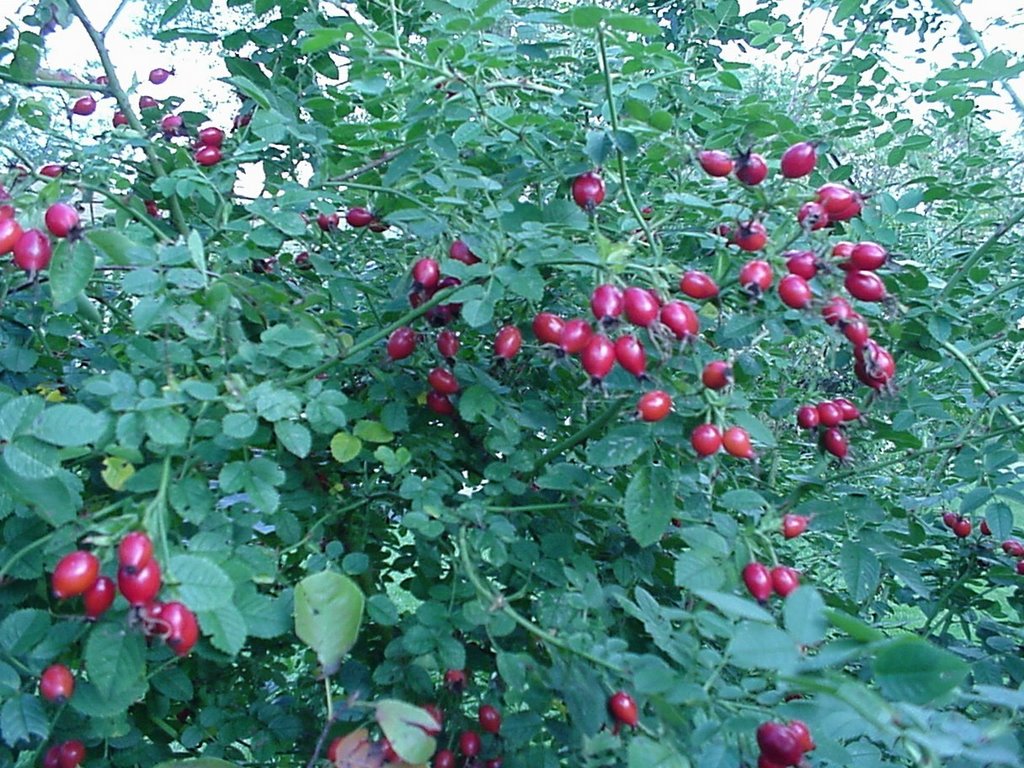
Out gathering more rose hips, these from the R. englatine (the one whose foliage smells like fresh green apples)and cleaning and drying them in the dehydrator for tea.
I clean them by cutting off the ends and scooping out the middle- seeds, furzy stuff, and once in a while a leetle white worm. Then pop the hips in the dehydrator.
Good for you.
Did I tell you my German-American friend, Ulrike's story about growing up poor in wartime Germany. The kids would pick rosehips on the way to school to eat, and scrape the furzy stuff in the middle out to use as "itching powder" to tease the other kids... Kids will be kids. I seem to remember reading that during the same war English kids were fed rosehips as well, both sides' children were sorely lacking good sources of Vitamin C, such as citrus fruit, and rose hips being the very best source of C and its accompanying bioflavinoids.
Check the C bottles next time you go past the Vitamin counter at the store, they still add rose hips to better brands.

Selasa, 12 September 2006
gather your roseHIPS while ye may... and make jam
 I know, it's rosebuds in the poem, and the common wisdom says gather rosehips after the first frost. (It supposedly kills any harboring insects.) But I like to pick them in the beginning of autumn, but before the frost hits, when they are ripened but still firm, like an apple. If you wait for the weather to turn you'll lose alot of them to drying up, mushiness, those little 'worms' will grow and ruin the fruit, and so on.
So I say, pick them NOW, and make jam...
Here's my Rosehip Jam recipe.
Pick some rosehips. I pick about a colander full. So you know right now, this recipe is not precise, but it works. Some say the big apple-y R. rugosa type are the best. They are big and pretty, and look like little apples... see the photo.
But this year I liked the hips from my R. glauca because it is so prolific and the hips are nice and clean of insects. Because I grow without chemicals, the R. rugosa has some little worms in many of the hips this year. Hey, I never promised you a rose garden. But the photo is pretty, isn't it.
Next, wash the hips, cut them all in half, then go through and clean out the seeds and little odd bits. Soak the cleaned hips in water (enough to cover) in the pot you will cook them in, for several hours, which will soften them.
Then when you are ready to make jam, bring the pot to a boil, and boil for 15 minutes, uncovered.
Strain the boiled water/juice into a large measuring cup. In this case I got 1 1/2 cups. Set the fruit aside, and add an equal measure of sugar (in this case, 1 1/2 cups sugar) to the liquid, and stir to dissolve it.
Boil the sugared water/juice until it thickens, stirring constantly.
Add the fruit and cook, stirring, until it is a nice jammy consistency.
Be careful not to burn it.
Your rosehip jam will be beautiful, it looks a bit like cherry jam.
Pour into clean jars and cap. Label, Store in the fridge.
In this case I got three jelly jars, filled. Here's a picture:

Minggu, 28 Mei 2006
Sprouting a 2,000 year old seed

Why did I post this year-old article, even if I just think it's interesting and garden-related?
Because it reminds us that we don't need to plant the WHOLE packet of seeds. Plant as many as you need, and a few to give away, and if you don't trust the germination rate or your luck, then plant a few extra. But then tape the package closed again, and for MOST seeds, you can save them in the back of the fridge to plant again.
I store them in a tightly sealing Tupperware-type box to keep them fresh. I've certainly planted 10-year old basil seeds with success.
This way, you can try something new next year, while still planting your favorite old stand-bys.
June 12, 2005
After 2,000 Years, a Seed From Ancient Judea Sprouts
By STEVEN ERLANGER
New York Times
JERUSALEM, June 11 - Israeli doctors and scientists have succeeded in germinating a date seed nearly 2,000 years old.
The seed, nicknamed Methuselah, was taken from an excavation at Masada, the cliff fortress where, in A.D. 73, 960 Jewish zealots died by their own hand, rather than surrender to a Roman assault. The point is to find out what was so exceptional about the original date palm of Judea, much praised in the Bible and the Koran for its shade, food, beauty and medicinal qualities, but long ago destroyed by the crusaders.
"The righteous shall flourish like the palm tree," says Psalm 92. "They shall still bring forth fruit in old age. They shall be fat and flourishing."
Well, we'll see. Dr. Sarah Sallon, who runs a project on medicinal plants of the Middle East, notes that the date palm in ancient times symbolized the tree of life. But Dr. Elaine Solowey, who germinated the seed and is growing it in quarantine, says plants grown from ancient seeds "usually keel over and die soon," having used most of their nutrients in remaining alive.
The plant is now 11.8 inches tall and has produced seven leaves, one of which was removed for DNA testing. Radiocarbon dating in Switzerland on a snip of the seed showed it to be 1,990 years old, plus or minus 50 years. So the date seed dates from 35 B.C. to A.D. 65, just before the famed Roman siege.
Three date seeds were taken from Level 34 of the Masada dig. They were found in a storeroom, and are presumably from dates eaten by the defenders, Dr. Sallon says.
Mordechai Kislef, director of botanical archeology at Bar-Ilan University, had some date seeds from Ehud Netzer, who excavated Masada in the 1970's. "They were sitting in a drawer, and when I asked for one, he said, 'You're mad,' but finally gave me three," Dr. Sallon said. "Then I gave them to Elaine, who's an expert on arid agriculture and dates." Dr. Solowey said: "Well, I didn't have much hope that any would come up, but you know how Sarah is."
Dr. Sallon, who is a pediatric gastroenterologist trained at University College, London, came to Israel 20 years ago. She is the director of the Louis L. Borick Natural Medicine Research Center at Hadassah Medical Organization, which she set up 10 years ago to study natural products and therapies, from Tibetan and Chinese medicine to the indigenous medicinal plants of the Middle East. The idea is to preserve these plants and their oral histories in a modernizing region, but also to domesticate them, evaluate them scientifically and then try to integrate them into conventional medicine.
Dr. Solowey, who teaches agriculture and sustainable farming at the Arava Institute for Environmental Studies, based at Kibbutz Ketura in the southern Negev, works on finding new crops for arid and saline areas like Jordan, Gaza and Morocco. She also works with Dr. Sallon to domesticate indigenous plants that appear to have medicinal uses.
Dr. Solowey grew up in the San Joaquin Valley in California and studied horticulture, then turned away from commercial agriculture in disgust, coming here in 1971. "I don't come to organic agriculture from the hippie side, but as a frustrated agricultural scientist," she said.
"We've bred for yield and taste, but not hardiness, so we have a lot of plants as hardy as French poodles, so we have to spray to protect them, and then we pay the price," she said. "There isn't a cubic centimeter of water in the San Joaquin Valley that isn't polluted with something."
She planted the date seeds at the end of January after trying to draw them out of their deep dormancy. She first soaked the seeds in hot water to soften the coat, then in an acid rich in hormones, then in an enzymatic fertilizer made of seaweed and other nutrients.
"I've done other recalcitrant seeds," she said. "It wasn't a project with a high priority. I had no idea if the food in the seed was still good, but I put them in new pots in new potting soil and plugged them into drip irrigation and kind of forgot about them."
About six weeks later, she said, "I saw the earth cracked in a pot and much to my astonishment, one of these came up."
The first two leaves looked odd, she said, very flat and pale. "But the third looked like a date leaf with lines, and every one since has looked more and more normal - like it had a hard time getting out of the seed."
Lotus seeds of about 1,200 years of age have been sprouted in China, and after the Nazis bombed London's Natural History Museum in World War II and a lot of water was used to put out the fire, seeds of 500 years of age also germinated.
"But no one had done it from 2,000 years old," Dr. Sallon said.
In the time of Pliny, forests of date palms covered the area from Lake Galilee to the Dead Sea and made Jericho famous; a date palm features on ancient coinage, as it does on the current Israeli 10-shekel coin.
The date palm symbolized ancient Israel; the honey of "the land of milk and honey" came from the date. It is praised as a tonic to increase longevity, as a laxative, as a cure for infections and as an aphrodisiac, Dr. Sallon said. But the dates of Judea were destroyed before the Middle Ages, and what dates Israel grows now were imported in the 1950's and 60's from California and originated elsewhere in the Middle East.
The Prophet Muhammad considered the date of great importance for medicine, food, construction and income, and it is described in the Koran as a "symbol of goodness" associated with heaven.
Dates need to grow 30 years to reach maturity and can live as long as 200 years.
But it is the female date that is considered holy, and that bears fruit. "Men are rather superfluous in the date industry," Dr. Sallon said.
"O.K, I have a date plant," Dr. Solowey said. "If it lives, it will be years before we eat any dates. And that's if it's female. There's a 50-50 chance. And if it's a male, it will just be a curiosity."
Rabu, 24 Mei 2006
plant a ginger today!
In the garden:
Commercial culinary ginger is Zingiber officinalis.
Requires little care. Keep moderately moist. 50% + humidity.
Ginger should receive full sun-to part shade. Humus-rich soil. ph 6.5 well drained soil.
Divide rhizomes in early spring; plant horizontally 1 inch deep.
Harvest: Rhizomes in late autumn, cutting off leafstalks and removing fibrous roots. Keep a rhizome to start the next year's plants.
I planted one in summer, 2000 from Meijer's produce department. It grew!
The stems and leaves were so thin they were surprising to me.
The leaves developed yellow spots but it didn't seem to hinder the plant. the stress of mind and hail shredded the leaves as well. Seems to need more protection from extreme weather.
In February, the stems and leaves turned yellow, one by one, and started to drop off (in the same way that voodoo lily scapes do, at the base). By Feb 25th the whole plant was dormant.
2001: The replanted rhizome did well, the leaves were healthier and not spotted at all this year. It produced a nice replacement rhizome as well as it's own smaller one. Behaved the same, but I guess it yellowed in mid-winter, maybe December. I left it out to dry and pretty well forgot it until March.
2002: Spring: still looks viable. Planted the best part in a 8" plastic pot, kept it outside in summer and indoors in winter. This one looks healthier than last year- the leaf fronds are thicker and taller. Started dying back again in January, and I quit watering, though I left it in the S window. Gradually died off, I unpotted it Jan. 30, 2003 and took a few pictures of the roots- healthy, the tubers are much rounder and shinier than the store-bought tubers. I am keeping one half, broken away as I unpotted it, to use, and one will be repotted right away.
The repotted root took a long time to resprout, with the cool spring, it may have been waiting for warmth?
Sept. 2003: The gingerroot in the refrigerator rotted/molded. I didn't use it!!!
The replanted root looks just great, best yet. No spots, no yellowing, no shredded leaves. But the root BURST its pot! Needs to be repotted.
I repotted it into a much larger clay pot, but cut half of the storage root off to use.
Time to start another ginger. Bought a big one in April in Meijers' produce department, and put it under the light, bare. May 2006: Cut it in three - one to use now, and two to plant in the big flat bowl-shaped pot. The nubby tips are turning green and the outermost tips are very green and starting to sprout.
(See ginger folder in 'Recipes' file...)
Buy fresh gingerroot at Meijers- costs about $2/lb. A very large root is about 1/2 lb, or 2 cups prepared fresh pieces. December 2000: I used the second recipe for candied gingerroot, the third looks good too.
The Best Use: peel and slice into vodka, store in refrigerator. Slices are useful indefinitely, the vodka picks up the ginger flavor.
OR- Candied Ginger
CANDIED GINGER
1 c Ginger Root -peeled and thinly sliced
1 c Water
1/2 c Maple Syrup
In a small saucepan stir together the ginger,water and maple syrup. Place over medium heat and simmer untill liquid is completely evaporated about 25 to 30 minutes. Watch carefully during the last 10 minutes of cooking to prevent syrup from burning. Seperate pieces and place on a lightely greased cooking cooling rack .Dry in a 200 degree oven untill all syrup is absorbed and pieces snap when broken,about 2 hours.
From Rodale Stocking up III cookbook.
Candied Ginger
HERB COMPANION, Oct/Nov 1997
1/2 pound fresh ginger
water to cover
1 1/2 cups sugar
1 1/2 cups water
2 tablespoons light corn syrup
Crystallizing ginger is a lengthy process, but having these choice sweets on hand is reward enough.
1. Peel 1/2 pound fresh ginger and slice 1/4 inch thick. Bring to a boil in water to cover. Simmer, covered for 2+1/2 hours. Drain, simmer in fresh water for another hour, or until tender. Drain.
2. Bring to a boil 1+1/2 cups sugar, 1+1/2 cups water, and 2 tablespoons light corn syrup; cook for 2 minutes. Add the ginger. Remove from the heat and let stand until cool, or overnight.
3. Again bring the syrup to a boil. Simmer, stirring occasionally, for 1 to 3 hours, or until the ginger is translucent. If the syrup thickens too quickly, thin with a little hot water.
4. Remove the pan from the heat and set the ginger pieces on a wire rack to dry for a few hours. Roll them in granulated sugar and store in a glass jar.
(May get moldy.)
Third recipe: Instructions:
Day 1: Scrape and cut into 1/4 inch slices enough non-fibrous young Ginger root to make 1 quart. Put the slices into a large non-aluminum pat and cover generously with water. Bring slowly to the boil, simmer, covered until tender (20 min). Add 1 cup sugar and stir until the mixture boils.
Remove from heat. Cover and let stand overnight at room temperature.
Day 2: Recook, simmering gently for about 15 min (after coming to the boil). Add 1 seeded sliced lemon and 1 cup light corn syrup. Uncover and simmer 15 minutes longer, stirring occasionally.
Remove from heat and let stand covered overnight.
Day 3: Bring the mixture to the boil again and add 1 cup sugar and simmer for 30 min STIRRING CONSTANTLY (burns easily). Add 1 cup sugar, bring back to the boil and remove from heat.
Cover and let stand overnight again.
Day 4: In the fourth cooking, bring the mixture to a boil once more. When the syrup drops heavily from the side of a spoon, and the ginger is translucent, pour the mixture into sterile jars and seal. This yields about 5 cups.
If you want Candied ginger...drain the ginger after the last cooking. Reserve the syrup for flavoring sauces and allow the slices to dry on a sheet or better still a rack, overnight. When well dried, roll in granulated sugar and store in tightly covered glass jars.
You can then boil the reserved liquid until it is reduced to a syrup with a consistency somewhere between maple syrup and honey. This will intensify its flavor. This syrup can be used for pancakes, waffles, or ice cream, and is an extra bonus for making your own candied ginger.
Ginger Compress
1/2 c Fresh Ginger Rhizome
2 c Water
[From Herbal Medicine for Dummies]
1. Grate the Ginger into a small saucepan.
2. Add the water and simmer for 15 minutes.
3. Let steep for 15 minutes.
4. Soak a washcloth in the strong tea and apply to painful or stiff muscles until the compress cools. Do this 3 to 4 times and then repeat the process 2 to 3 times a day.
Vary it: For inflamed muscles and strong pain, try alternating the ginger compress with a cold or even icy compress with 1 minute of the cold to 4 minutes of the hot.
Notes: Try this ginger compress for back strains, sprains, bruises, and other injuries. You gain the most benefit with this herbal treatment by using it several times a day for a few days.
Ginger Info
(Zingiber officinale) The feeling of nausea is a symptom
that can accompany a wide range of organic or metabolic
disorders and emotional trauma. Ginger is used for all
types of nausea, including morning sickness and motion
sickness. It has a warming effect and is supportive to the
digestion while stimulating circulation.
Ginger has a protective effect on the stomach and liver
as well, and is the best spice to use for people with liver
and digestive problems. It is taken as a powder in capsules
for alleviating nausea (2 capsules 3 times daily), as a tea
by simmering dried or fresh ginger slices, or as a tincture
(2 droppersful 2 to 3 times daily).
==================================
GINGER (herb of the Moon) -- used to make sure
your spells are effective. Ginger is eaten before spells
to make them successful, or simply added to herbal
mixtures, also used for love spells.
=========================
From: Herbs for the Home, McVicar
This is good for indigestion, flatulence, nausea, and
poor circulation. Chewing a piece of any ginger is an
effective deterrent to travel sickness. Ginger tea
is good for flus and colds.
========================
LLewllyn's 1999 Magical Almanac
Ginger, know in ancient China and India, tones,
uplifts and warms the system, stimulates digestion
and circulation, calms upset stomach, and relieves
nausea, aches and pains. Ginger can be eaten in
candied slices, honey-based syrups, encapsulated
or drunk as a tea.
===============================
Ginger Tea helps appetite loss, motion sickness,
up-set stomach, relieves gas, loosens phlegm, and
soothes earaches. To 1 teaspoon of ginger add 1 cup
boiling water. Steep 5 minutes. (By Diane Kennedy
Snyder of Diane's Herbal Shop )
============================
Ginger: masculine, Mars, Fire. Magical attributes:
Power, success, love. History/Uses: Back to Egypt
in the time of Cheops, people were making gingerbread;
4400 years ago, the Chinese were importing this
herb for the same reason, and to act as an aid to
indigestion or colds (tea form).
Carry the root of ginger in your purse to ensure
prosperity, or make it into a fine drink for summer
days.
Commercial culinary ginger is Zingiber officinalis.
Requires little care. Keep moderately moist. 50% + humidity.
Ginger should receive full sun-to part shade. Humus-rich soil. ph 6.5 well drained soil.
Divide rhizomes in early spring; plant horizontally 1 inch deep.
Harvest: Rhizomes in late autumn, cutting off leafstalks and removing fibrous roots. Keep a rhizome to start the next year's plants.
I planted one in summer, 2000 from Meijer's produce department. It grew!
The stems and leaves were so thin they were surprising to me.
The leaves developed yellow spots but it didn't seem to hinder the plant. the stress of mind and hail shredded the leaves as well. Seems to need more protection from extreme weather.
In February, the stems and leaves turned yellow, one by one, and started to drop off (in the same way that voodoo lily scapes do, at the base). By Feb 25th the whole plant was dormant.
2001: The replanted rhizome did well, the leaves were healthier and not spotted at all this year. It produced a nice replacement rhizome as well as it's own smaller one. Behaved the same, but I guess it yellowed in mid-winter, maybe December. I left it out to dry and pretty well forgot it until March.
2002: Spring: still looks viable. Planted the best part in a 8" plastic pot, kept it outside in summer and indoors in winter. This one looks healthier than last year- the leaf fronds are thicker and taller. Started dying back again in January, and I quit watering, though I left it in the S window. Gradually died off, I unpotted it Jan. 30, 2003 and took a few pictures of the roots- healthy, the tubers are much rounder and shinier than the store-bought tubers. I am keeping one half, broken away as I unpotted it, to use, and one will be repotted right away.
The repotted root took a long time to resprout, with the cool spring, it may have been waiting for warmth?
Sept. 2003: The gingerroot in the refrigerator rotted/molded. I didn't use it!!!
The replanted root looks just great, best yet. No spots, no yellowing, no shredded leaves. But the root BURST its pot! Needs to be repotted.
I repotted it into a much larger clay pot, but cut half of the storage root off to use.
Time to start another ginger. Bought a big one in April in Meijers' produce department, and put it under the light, bare. May 2006: Cut it in three - one to use now, and two to plant in the big flat bowl-shaped pot. The nubby tips are turning green and the outermost tips are very green and starting to sprout.
(See ginger folder in 'Recipes' file...)
Buy fresh gingerroot at Meijers- costs about $2/lb. A very large root is about 1/2 lb, or 2 cups prepared fresh pieces. December 2000: I used the second recipe for candied gingerroot, the third looks good too.
The Best Use: peel and slice into vodka, store in refrigerator. Slices are useful indefinitely, the vodka picks up the ginger flavor.
OR- Candied Ginger
CANDIED GINGER
1 c Ginger Root -peeled and thinly sliced
1 c Water
1/2 c Maple Syrup
In a small saucepan stir together the ginger,water and maple syrup. Place over medium heat and simmer untill liquid is completely evaporated about 25 to 30 minutes. Watch carefully during the last 10 minutes of cooking to prevent syrup from burning. Seperate pieces and place on a lightely greased cooking cooling rack .Dry in a 200 degree oven untill all syrup is absorbed and pieces snap when broken,about 2 hours.
From Rodale Stocking up III cookbook.
Candied Ginger
HERB COMPANION, Oct/Nov 1997
1/2 pound fresh ginger
water to cover
1 1/2 cups sugar
1 1/2 cups water
2 tablespoons light corn syrup
Crystallizing ginger is a lengthy process, but having these choice sweets on hand is reward enough.
1. Peel 1/2 pound fresh ginger and slice 1/4 inch thick. Bring to a boil in water to cover. Simmer, covered for 2+1/2 hours. Drain, simmer in fresh water for another hour, or until tender. Drain.
2. Bring to a boil 1+1/2 cups sugar, 1+1/2 cups water, and 2 tablespoons light corn syrup; cook for 2 minutes. Add the ginger. Remove from the heat and let stand until cool, or overnight.
3. Again bring the syrup to a boil. Simmer, stirring occasionally, for 1 to 3 hours, or until the ginger is translucent. If the syrup thickens too quickly, thin with a little hot water.
4. Remove the pan from the heat and set the ginger pieces on a wire rack to dry for a few hours. Roll them in granulated sugar and store in a glass jar.
(May get moldy.)
Third recipe: Instructions:
Day 1: Scrape and cut into 1/4 inch slices enough non-fibrous young Ginger root to make 1 quart. Put the slices into a large non-aluminum pat and cover generously with water. Bring slowly to the boil, simmer, covered until tender (20 min). Add 1 cup sugar and stir until the mixture boils.
Remove from heat. Cover and let stand overnight at room temperature.
Day 2: Recook, simmering gently for about 15 min (after coming to the boil). Add 1 seeded sliced lemon and 1 cup light corn syrup. Uncover and simmer 15 minutes longer, stirring occasionally.
Remove from heat and let stand covered overnight.
Day 3: Bring the mixture to the boil again and add 1 cup sugar and simmer for 30 min STIRRING CONSTANTLY (burns easily). Add 1 cup sugar, bring back to the boil and remove from heat.
Cover and let stand overnight again.
Day 4: In the fourth cooking, bring the mixture to a boil once more. When the syrup drops heavily from the side of a spoon, and the ginger is translucent, pour the mixture into sterile jars and seal. This yields about 5 cups.
If you want Candied ginger...drain the ginger after the last cooking. Reserve the syrup for flavoring sauces and allow the slices to dry on a sheet or better still a rack, overnight. When well dried, roll in granulated sugar and store in tightly covered glass jars.
You can then boil the reserved liquid until it is reduced to a syrup with a consistency somewhere between maple syrup and honey. This will intensify its flavor. This syrup can be used for pancakes, waffles, or ice cream, and is an extra bonus for making your own candied ginger.
Ginger Compress
1/2 c Fresh Ginger Rhizome
2 c Water
[From Herbal Medicine for Dummies]
1. Grate the Ginger into a small saucepan.
2. Add the water and simmer for 15 minutes.
3. Let steep for 15 minutes.
4. Soak a washcloth in the strong tea and apply to painful or stiff muscles until the compress cools. Do this 3 to 4 times and then repeat the process 2 to 3 times a day.
Vary it: For inflamed muscles and strong pain, try alternating the ginger compress with a cold or even icy compress with 1 minute of the cold to 4 minutes of the hot.
Notes: Try this ginger compress for back strains, sprains, bruises, and other injuries. You gain the most benefit with this herbal treatment by using it several times a day for a few days.
Ginger Info
(Zingiber officinale) The feeling of nausea is a symptom
that can accompany a wide range of organic or metabolic
disorders and emotional trauma. Ginger is used for all
types of nausea, including morning sickness and motion
sickness. It has a warming effect and is supportive to the
digestion while stimulating circulation.
Ginger has a protective effect on the stomach and liver
as well, and is the best spice to use for people with liver
and digestive problems. It is taken as a powder in capsules
for alleviating nausea (2 capsules 3 times daily), as a tea
by simmering dried or fresh ginger slices, or as a tincture
(2 droppersful 2 to 3 times daily).
==================================
GINGER (herb of the Moon) -- used to make sure
your spells are effective. Ginger is eaten before spells
to make them successful, or simply added to herbal
mixtures, also used for love spells.
=========================
From: Herbs for the Home, McVicar
This is good for indigestion, flatulence, nausea, and
poor circulation. Chewing a piece of any ginger is an
effective deterrent to travel sickness. Ginger tea
is good for flus and colds.
========================
LLewllyn's 1999 Magical Almanac
Ginger, know in ancient China and India, tones,
uplifts and warms the system, stimulates digestion
and circulation, calms upset stomach, and relieves
nausea, aches and pains. Ginger can be eaten in
candied slices, honey-based syrups, encapsulated
or drunk as a tea.
===============================
Ginger Tea helps appetite loss, motion sickness,
up-set stomach, relieves gas, loosens phlegm, and
soothes earaches. To 1 teaspoon of ginger add 1 cup
boiling water. Steep 5 minutes. (By Diane Kennedy
Snyder of Diane's Herbal Shop )
============================
Ginger: masculine, Mars, Fire. Magical attributes:
Power, success, love. History/Uses: Back to Egypt
in the time of Cheops, people were making gingerbread;
4400 years ago, the Chinese were importing this
herb for the same reason, and to act as an aid to
indigestion or colds (tea form).
Carry the root of ginger in your purse to ensure
prosperity, or make it into a fine drink for summer
days.
Langganan:
Postingan (Atom)