" What was Paradise?
But a Garden,
An orchard of trees,
and Herbs
Full of pleasure, and
Nothing there but Delights."
- William Lawson
Tampilkan postingan dengan label history. Tampilkan semua postingan
Tampilkan postingan dengan label history. Tampilkan semua postingan
Sabtu, 21 Agustus 2010
Sabtu, 27 Februari 2010
quote
"Time is an herb that cures all disease."
- Benjamin Franklin
Spoken as if "herbs" were commonly accepted as a medicine in Ben's era, which they were.
NOTE for those who may have been wondering, especially after all of those made up quotations about freedom and so on that were exposed as fraudulent during the last election cycle... about whether I've sourced all of these quotes in a properly scholarly manner. Sadly, no. I just run across neat thoughts everywhere, and like a crow that pecks up shiny objects, I take them home to my nest. If they shine for you, use them at your own risk.

Jumat, 12 Februari 2010
New Jersey Tea
Genesee County Herb Society / February 2010, Herb Study
Common names: Redroot (Red Root), New Jersey Tea, Jersey Root, Walpole Tea, Wild Snowball, Mountain-sweet, (Western var. California Lilac)
Latin name: Ceanothus americanus / Family: Rhamnaceae (Buckthorn)
C. americanus is an easily grown native shrub of eastern (as far west as MN) North America. Other more attractive varieties from western N. Am. are not cold hardy in our Mid Michigan hardiness zone and are not the varieties of historical importance.
Cultivation: Zone 4-8 (western varieties are not cold hardy here)
Ht: to 2-3'. Woody shrub with showy clusters of white blooms on new growth during whole summer. Leaves are toothed oval, textured and parallel veined. Roots have a reddish outer skin.
Prefers full sun to light shade, poor soil, not too damp. Not fussy, except can suffer rot from ‘wet feet’. Can be pruned hard in early spring (like a Spirea).
Flowers are attractive to bees, hummingbirds and butterflies.
Roots have nitrogen fixing nodules and a reddish colored epidermis.
Harvest leaves for tisane. Dried leaves have more flavor of "China tea” (Thea sinensis). Frontier offers wild crafted, cut leaves from the U.S. 5 cups per pound, starts at $12.70/lb. Richters sells dried cut root $7 for 50g (1 2/3 oz.), and seeds (pkt: $5 plus shipping).
To Use as a Herbal Tisane (herb tea): 1 t. dry leaves per cup of boiling water (or 1 Tbsp. fresh leaves). Steep 5-15 minutes. Sweetener and milk or cream helps flavor.
History and Folklore: Eastern tribes made a sedative tea from the root, and a skin treatment from an infusion of the whole plant. (Native Harvests by Barrie Kavasch)
Am. Indians used root tea for colds, fevers, snakebite, stomachache, lung ailments, laxative, blood tonic. Root is strongly astringent (8% tannin), expectorant, sedative. (Peterson Field Guides - Eastern/Central Medicinal Plants by Steven Foster and James Duke) Root tea was used for dysentery, asthma, sore throat, bronchitis, whooping cough, spleen inflammation or pain. Richters Herb Catalogue notes Indians used it for skin problems, skin cancer, venereal sores, and says tisane is a good gargle for mouth and sore throats.
Alkaloid in root is mildly ‘hypotensive’ (lowers blood pressure).
1758 - part of a Cherokee syphilis cure that reportedly worked in one week, which used a combination of Mayapple root, Lobelia root, Wild Cherry bark, with the powdered root of Redroot applied topically. (Planting the Future - Saving Our Medicinal Herbs, Edited by Rosemary Gladstar and Pamela Hirsch) English colonial doctors who used only Lobelia and were disappointed.
Note: Walpole Tea? Robert Walpole was the first Prime Minister of Britain. There are also a couple of New England towns and a bay named Walpole, so it could be a geographic reference. Geographical locations named after the PM.)
Civil War doctors used a Ceanothus decoction for "ague cake" or malarial 'splenitis'. (Henrietta Kress)
The dye is reported to produce a rich cinnamon brown shade. (No mordant mentioned, and I assume that means the root, since the tisane is a very pale shade of golden.)
Here is a photo I took last year at the County Extension's Backyard Herb Garden, right before garden tour weekend. (Just a reminder, if you click on the photo you can see an enlarged version of it.)

Liberty Tea—America’s First “Buy American” Campaign
The Boston Tea Party of December 16, 1773 was a grassroots, direct action protest against import taxes on imported Chinese tea, which were imposed by the British crown on the American colonies.
After dumping 343 barrels of imported Chinese tea into Boston Harbor, American colonists boycotted the British Empire’s tea and substituted local native herbs as their beverage of choice. They even went so far as to spread rumors about the unhealthful aspects of Tea.
The colonist’s first choice for "Liberty Tea" was the herbaceous perennial Monarda (then known as Oswego, now as Bee Balm) and northern colonials also preferred Labrador Tea while more southerly colonials preferred New Jersey Tea. (Eat the Weeds by Ben Charles Harris)
Raspberry leaves, various mints, and sarsaparilla are also mentioned in the folklore of the boycott.
Drinking Liberty Tea became a patriotic political statement that encouraged unity in the years of the American Revolutionary War. These native American herbs have a similar astringent flavor and healthful properties to Tea, but without the caffeine.
NOTE: Our tea bags to sample at the meeting were of a Liberty Tea blend that was harvested late last summer from shrubs at the Extension herb garden. I blended a pinch of Monarda blossoms into each tea bag before sealing, which improved the flavor of the tea considerably!
Minggu, 01 Maret 2009
Wear A Leek for Saint Dave Today
Or a daffodil! Here's a photo of the first garden stepping stone I ever made - it's seen the passing of many winters and I keep it in a spot where the snow melts earlier. Signs of spring are beginning to occur - the snowdrops and some early winter aconites are forming flowers, though they haven't opened yet, and the primroses and seed packets have arrived at Meijers, to bring home with the groceries.

March 1, Wear a Daffodil or Leek for St. David of Wales
From Wikipedia.com:
"Saint David's Day . . . is the feast day of Saint David, the patron saint of Wales, and falls on March 1 each year. The date . . . was chosen in remembrance of the death of Saint David on that day in 589, and has been celebrated . . . since then. The date was declared a national day of celebration . . . in the 18th century.
"On this day many Welsh people wear one or both of the national emblems of Wales on their lapel to celebrate: the daffodil (a generic Welsh symbol . . .) or the leek (Saint David's personal symbol). The association between leeks and daffodils is strengthened by the fact that they have similar names in Welsh, cenin (leek) and cenin Bedr (daffodil, literally "Peter's leek").
"In south Wales males usually wear leeks while young girls wear daffodils; in the north the daffodil predominates."

March 1, Wear a Daffodil or Leek for St. David of Wales
From Wikipedia.com:
"Saint David's Day . . . is the feast day of Saint David, the patron saint of Wales, and falls on March 1 each year. The date . . . was chosen in remembrance of the death of Saint David on that day in 589, and has been celebrated . . . since then. The date was declared a national day of celebration . . . in the 18th century.
"On this day many Welsh people wear one or both of the national emblems of Wales on their lapel to celebrate: the daffodil (a generic Welsh symbol . . .) or the leek (Saint David's personal symbol). The association between leeks and daffodils is strengthened by the fact that they have similar names in Welsh, cenin (leek) and cenin Bedr (daffodil, literally "Peter's leek").
"In south Wales males usually wear leeks while young girls wear daffodils; in the north the daffodil predominates."
Senin, 08 Desember 2008
A winter's tale
Victory gardens! The basic sustainable living idea whose time has come again, I'd say. I borrowed this historically relevant video circa 1943 from City Farmer to share with you. Click on the links to see all of City Farmer's videos.
Watch 1943 - You Cannot Eat Lilies - Victory Garden Video in How to Videos | View More Free Videos Online at Veoh.com
Watch 1943 - You Cannot Eat Lilies - Victory Garden Video in How to Videos | View More Free Videos Online at Veoh.com
Sabtu, 22 Desember 2007
Good Morning, Starshine...
the Earth says 'Hello'...
You twinkle above us...
We twinkle below.
"It is true that we need the land, but that is not the whole story; for the land also needs the people. It needs to feel the pounding of our feet to the rhythm of the dance, needs to hear the laughter of our children and it needs to hear the ancient stories told in a sacred manner." -saying of native people of Central Australia
My Farmer's Almanac tells me that the shortest day of the year, what pagan people honored in worship as the Solstice, is "around" December 21, yesterday. That means this morning's sunrise is the sunrise that milleniums of people around the world have celebrated.
Herb's radio playing Scott Horton interviewing the other Scott Horton woke me up before dawn today, and a few minutes later I was dancing in the shower to the storyteller's steel drum poem playing on NPR's Living on Earth (what a great show) ... That is called waking up on the right side of the bed.
In a happy spirit and guided by intuition, which is the best way, I thought to play Google's 'I Feel Lucky' and search for the words solstice legend. The first site I looked at gave me the quotation above, which I feel is perfectly fitting for today's inspiration. As you can see it is still dark outside, so I think I'll pause now, make a cup of coffee, and greet the sun.
You twinkle above us...
We twinkle below.
"It is true that we need the land, but that is not the whole story; for the land also needs the people. It needs to feel the pounding of our feet to the rhythm of the dance, needs to hear the laughter of our children and it needs to hear the ancient stories told in a sacred manner." -saying of native people of Central Australia
My Farmer's Almanac tells me that the shortest day of the year, what pagan people honored in worship as the Solstice, is "around" December 21, yesterday. That means this morning's sunrise is the sunrise that milleniums of people around the world have celebrated.
Herb's radio playing Scott Horton interviewing the other Scott Horton woke me up before dawn today, and a few minutes later I was dancing in the shower to the storyteller's steel drum poem playing on NPR's Living on Earth (what a great show) ... That is called waking up on the right side of the bed.
In a happy spirit and guided by intuition, which is the best way, I thought to play Google's 'I Feel Lucky' and search for the words solstice legend. The first site I looked at gave me the quotation above, which I feel is perfectly fitting for today's inspiration. As you can see it is still dark outside, so I think I'll pause now, make a cup of coffee, and greet the sun.
Kamis, 13 Desember 2007
a no-cost no-cal gift for my gardening friends
Nationally known gardener Ken Druse and his garden buddy Vickie Johnson have been broadcasting an enjoyable weekly radio program for some time now, and here is the link to listen online:
Real Dirt Radio
For folks who "Ipod" (in other words listen to an .mp3 player) or who can listen online, the show (and the past the archived episodes - 25 or so) is available for free from Apple's ITunes store (Google it). Just type Real Dirt into the search box in the upper corner of the ITunes store and subscribe for free from the results page.
By Sheer Coincidence, on the very week when I sent this message to our Master Gardener volunteer coordinator to share on her list-serve, Ken and Vickie were discussing herbs and the Herb Society of America.
Vickie was telling about this year's collaboration between the HSA and Park Seed, that you will see when you get your Park Seed Catalogue. (Every gardener in America gets the Park Seed Cat, right?)
As I understand it, a committee within the HSA made a list of their Top Ten Easy and Annual Herbs, and Park will be selling a promotional package (link) in coordination with the 75th Anniversary of the HSA.
I must comment on both Park Seed and the HSA. The Park Seed catalogue is how I got into growing plants from seed so many years ago. It was my winter dream book. I grew unusual things from seed back in the days when our local nurseries only carried common plants and trips to Bordines Nursery were reserved for my birthday.
The Park Seed catalogue introduced me to the world of plants and led me to look for more seed sources, down the road to J.L. Hudson Seedsman, Richter's, and more.
Obviously, a seed packet can stretch the budget, but growing plants from seed gives a depth of knowledge that buying transplants does not. Following this thought back to herbs, if you are thinking of using your plants (herbs are useful plants by definition), you simply must know their Latin name. For instance, look at the sorrel in the Park package... it is NOT the same sorrel as you will find growing in the vacant lot. Learning to look for the right variety of a plant means learning their names. Common names are not adequate for a true herbie.
I've heard some (usually inexperienced) gardeners dismiss bionomial nomenclature as high hat, for instance, but if you are an avid garden catalogue reader, you learn botanical latin as if by osmosis. And once naming plants properly takes root, you only feel silly with pronunciation, which fortunately can become an ice-breaker in conversation if handled well.
I've read that no one really knows how Latin was pronounced in Classical Roman times (any more than a typical modern American would understand spoken Middle English) and binomial nomenclature only really gained popularity with Carolus Linneaus in the 1700s, so I personally give people the benefit of the doubt when they try talking about Clematis or Yucca and hope for the same grace in return.
Pronunciation is not the point, what the person is saying about the plant is what matters. But we need to be talking about the same plant, especially if we intend to use it herbally. But enough said about the common name-botanical Latin debate, I digress. Things have really changed since the 1970s, and we have all kinds of plant and seed selection we never had before, but the Park Seed catalogue is still great for a cozy winter afternoon read.
Whenever I go through my old seed stash that I store in a Tupperware box in the back of the fridge, I'll run across those little gold foil packets from Park Seed and recall the years ago gardens when I grew this or that, reliving good memories.
My seeds might be past viability but my memories were only dormant.
And Congratulations on your 75th anniversary and Thank you to the Herb Society of America. The HSA was founded back when herbs were certainly underappreciated and almost forgotten as garden plants. The Herb Society of America was a force behind changing all of that. They showed us what a small group of committed gardeners could do.
Real Dirt Radio
For folks who "Ipod" (in other words listen to an .mp3 player) or who can listen online, the show (and the past the archived episodes - 25 or so) is available for free from Apple's ITunes store (Google it). Just type Real Dirt into the search box in the upper corner of the ITunes store and subscribe for free from the results page.
By Sheer Coincidence, on the very week when I sent this message to our Master Gardener volunteer coordinator to share on her list-serve, Ken and Vickie were discussing herbs and the Herb Society of America.
Vickie was telling about this year's collaboration between the HSA and Park Seed, that you will see when you get your Park Seed Catalogue. (Every gardener in America gets the Park Seed Cat, right?)
As I understand it, a committee within the HSA made a list of their Top Ten Easy and Annual Herbs, and Park will be selling a promotional package (link) in coordination with the 75th Anniversary of the HSA.
I must comment on both Park Seed and the HSA. The Park Seed catalogue is how I got into growing plants from seed so many years ago. It was my winter dream book. I grew unusual things from seed back in the days when our local nurseries only carried common plants and trips to Bordines Nursery were reserved for my birthday.
The Park Seed catalogue introduced me to the world of plants and led me to look for more seed sources, down the road to J.L. Hudson Seedsman, Richter's, and more.
Obviously, a seed packet can stretch the budget, but growing plants from seed gives a depth of knowledge that buying transplants does not. Following this thought back to herbs, if you are thinking of using your plants (herbs are useful plants by definition), you simply must know their Latin name. For instance, look at the sorrel in the Park package... it is NOT the same sorrel as you will find growing in the vacant lot. Learning to look for the right variety of a plant means learning their names. Common names are not adequate for a true herbie.
I've heard some (usually inexperienced) gardeners dismiss bionomial nomenclature as high hat, for instance, but if you are an avid garden catalogue reader, you learn botanical latin as if by osmosis. And once naming plants properly takes root, you only feel silly with pronunciation, which fortunately can become an ice-breaker in conversation if handled well.
I've read that no one really knows how Latin was pronounced in Classical Roman times (any more than a typical modern American would understand spoken Middle English) and binomial nomenclature only really gained popularity with Carolus Linneaus in the 1700s, so I personally give people the benefit of the doubt when they try talking about Clematis or Yucca and hope for the same grace in return.
Pronunciation is not the point, what the person is saying about the plant is what matters. But we need to be talking about the same plant, especially if we intend to use it herbally. But enough said about the common name-botanical Latin debate, I digress. Things have really changed since the 1970s, and we have all kinds of plant and seed selection we never had before, but the Park Seed catalogue is still great for a cozy winter afternoon read.
Whenever I go through my old seed stash that I store in a Tupperware box in the back of the fridge, I'll run across those little gold foil packets from Park Seed and recall the years ago gardens when I grew this or that, reliving good memories.
My seeds might be past viability but my memories were only dormant.
And Congratulations on your 75th anniversary and Thank you to the Herb Society of America. The HSA was founded back when herbs were certainly underappreciated and almost forgotten as garden plants. The Herb Society of America was a force behind changing all of that. They showed us what a small group of committed gardeners could do.
Minggu, 20 Mei 2007
Mrs. Beeton and The Martha
Herb is fishing up north of Wawa Ontario somewhere, and I'm right now watching a wonderful juicy Masterpiece Theatre Victorian version of the life of the original 'The Martha' ... Mrs. Isabella Beeton. The actress portraying Mrs. Beeton has a body language and facial expression and control that in her character's times of adversity will touch a chord. From beyond the grave her narration logically analyses and explains her life ... and reveals the human background to her 'Book of Household Management'.
Immediately I thought of the Gutenberg Project, and, applying Google, I found a zip file as well as a fine website allowing us to read the original online... I'd love to find a free online photocopy with the original typeset, like the American Victorian household management book I mentioned in an earlier post from the University of Michigan. Something to put on the to-do list for another day.
I must mention, that when I read 'Just Desserts' years ago, I had a new appreciation of Martha Stewart's rise to fame. There was a human story behind both of these household diva superstars. Never having been a soap fan or a watcher of television celebrity, I'm probably not as jaded as the average American to stories like these.
Immediately I thought of the Gutenberg Project, and, applying Google, I found a zip file as well as a fine website allowing us to read the original online... I'd love to find a free online photocopy with the original typeset, like the American Victorian household management book I mentioned in an earlier post from the University of Michigan. Something to put on the to-do list for another day.
I must mention, that when I read 'Just Desserts' years ago, I had a new appreciation of Martha Stewart's rise to fame. There was a human story behind both of these household diva superstars. Never having been a soap fan or a watcher of television celebrity, I'm probably not as jaded as the average American to stories like these.
Senin, 26 Februari 2007
tea receipt from Queen Victoria's time
(As usual, for a big picture, click on the picture.)
Did Victorian era housewives commonly infuse their (black) tea for 20 minutes and then add the infusion to the pot with hot water? I wonder what Elizabeth would have thought about our newfangled tea bags?


Did Victorian era housewives commonly infuse their (black) tea for 20 minutes and then add the infusion to the pot with hot water? I wonder what Elizabeth would have thought about our newfangled tea bags?

Minggu, 25 Februari 2007
a blast from the past
Net-surfing is fun... you NEVER know what you'll run across. Television can't compete!
This book (click on the title page to enlarge)written for 1865 housewives is readable one page at a time, online if you follow this link to the University of Michigan Humanities Text Initiative.
Just posting the title page now, I'll be back tomorrow with something from the book for my herbie pals.

This book (click on the title page to enlarge)written for 1865 housewives is readable one page at a time, online if you follow this link to the University of Michigan Humanities Text Initiative.
Just posting the title page now, I'll be back tomorrow with something from the book for my herbie pals.
Rabu, 24 Januari 2007
For Robert Burns
His birthday is tomorrow.
Selkirk Grace
Some hae meat and cannot eat.
Some cannot eat that want it:
But we hae meat and we can eat,
Sae let the Lord be thankit.
This following Burns Supper Format I copied from the official Burns Supper website where you can find the recipes and a sample of Burns poetry.
Just thinking, the Cock-a-Leekie soup is pretty similar to the Leek and Potato Soup recipe that Norma posted in the GCHS Yahoo Group that she served at the January meeting. I'm thinking of making it for dinner tomorrow night. I'll have to call mine Turk-a-Leekie though, as I'm out of frozen chicken broth and will be using my frozen turkey broth instead. I don't think any true Scotsman would decry the substitution, thriftiness being a virtue.
Burns Suppers have been part of Scottish culture for about 200 years as a means of commemorating our best loved bard. And when Burns immortalised haggis in verse he created a central link that is maintained to this day.
The ritual was started by close friends of Burns a few years after his death in 1796 as a tribute to his memory. The basic format for the evening has remained unchanged since that time and begins when the chairman invites the company to receive the haggis.
THE FORMAT FOR A BURNS SUPPER
Chairperson's opening address
A few welcoming words start the evening and the meal commences with the Selkirk Grace
The company are asked to stand to receive the haggis. A piper then leads the chef, carrying the haggis to the top table, while the guests accompany them with a slow handclap. The chairman or invited guest then recites Burns' famous poem To A Haggis, with great enthusiasm. When he reaches the line 'an cut you up wi' ready slight', he cuts open the haggis with a sharp knife.
It's customary for the company to applaud the speaker then stand and toast the haggis with a glass of whisky.
The company will then dine. A typical Bill o' Fare would be:
Cock-a-leekie soup
*
Haggis warm reeking, rich wi' Champit Tatties, Bashed Neeps
*
Tyspy Laird (sherry trifle)
*
A Tassie o' coffee
The Immortal Memory
One of the central features of the evening. An invited guest is asked to give a short speech on Burns. There are many different types of Immortal Memory speeches, from light-hearted to literary, but the aim is the same - to outline the greatness and relevance of the poet today.
Toast To The Lasses
The main speech is followed by a more light-hearted address to the women in the audience. Originally this was a thank you to the ladies for preparing the food and a time to toast the 'lasses' in Burns' life. The tone should be witty, but never offensive, and should always end on a concilliatory note.
Response
The turn of the lasses to detail men's foibles. Again, should be humorous but not insulting.
Poem and Songs
Once the speeches are complete the evening continues with songs and poems. These should be a good variety to fully show the different moods of Burns muse. Favourites for recitations are Tam o' Shanter, Address to the Unco Guid, To A Mouse and Holy Willie's Prayer.
The evening will culminate with the company standing, linking hands and singing Auld Lang Syne to conclude the programme.
Selkirk Grace
Some hae meat and cannot eat.
Some cannot eat that want it:
But we hae meat and we can eat,
Sae let the Lord be thankit.
This following Burns Supper Format I copied from the official Burns Supper website where you can find the recipes and a sample of Burns poetry.
Just thinking, the Cock-a-Leekie soup is pretty similar to the Leek and Potato Soup recipe that Norma posted in the GCHS Yahoo Group that she served at the January meeting. I'm thinking of making it for dinner tomorrow night. I'll have to call mine Turk-a-Leekie though, as I'm out of frozen chicken broth and will be using my frozen turkey broth instead. I don't think any true Scotsman would decry the substitution, thriftiness being a virtue.
Burns Suppers have been part of Scottish culture for about 200 years as a means of commemorating our best loved bard. And when Burns immortalised haggis in verse he created a central link that is maintained to this day.
The ritual was started by close friends of Burns a few years after his death in 1796 as a tribute to his memory. The basic format for the evening has remained unchanged since that time and begins when the chairman invites the company to receive the haggis.
THE FORMAT FOR A BURNS SUPPER
Chairperson's opening address
A few welcoming words start the evening and the meal commences with the Selkirk Grace
The company are asked to stand to receive the haggis. A piper then leads the chef, carrying the haggis to the top table, while the guests accompany them with a slow handclap. The chairman or invited guest then recites Burns' famous poem To A Haggis, with great enthusiasm. When he reaches the line 'an cut you up wi' ready slight', he cuts open the haggis with a sharp knife.
It's customary for the company to applaud the speaker then stand and toast the haggis with a glass of whisky.
The company will then dine. A typical Bill o' Fare would be:
Cock-a-leekie soup
*
Haggis warm reeking, rich wi' Champit Tatties, Bashed Neeps
*
Tyspy Laird (sherry trifle)
*
A Tassie o' coffee
The Immortal Memory
One of the central features of the evening. An invited guest is asked to give a short speech on Burns. There are many different types of Immortal Memory speeches, from light-hearted to literary, but the aim is the same - to outline the greatness and relevance of the poet today.
Toast To The Lasses
The main speech is followed by a more light-hearted address to the women in the audience. Originally this was a thank you to the ladies for preparing the food and a time to toast the 'lasses' in Burns' life. The tone should be witty, but never offensive, and should always end on a concilliatory note.
Response
The turn of the lasses to detail men's foibles. Again, should be humorous but not insulting.
Poem and Songs
Once the speeches are complete the evening continues with songs and poems. These should be a good variety to fully show the different moods of Burns muse. Favourites for recitations are Tam o' Shanter, Address to the Unco Guid, To A Mouse and Holy Willie's Prayer.
The evening will culminate with the company standing, linking hands and singing Auld Lang Syne to conclude the programme.
Sabtu, 03 Juni 2006
salad days
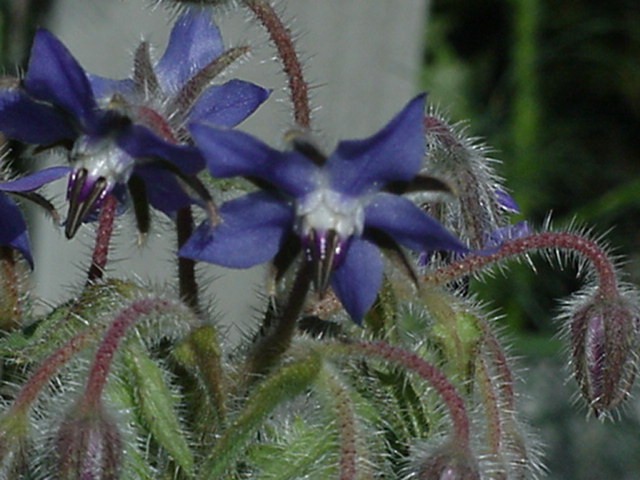
Springtime Herb and Flower Salad (Scottish, Medieval)
Yield: 6 Servings
(British Measurements)
2 bn Watercress
1 pk Mustard greens & cress
2 oz Fresh parsley sprigs
1 Leek; finely sliced
6 Spring onions; chopped
1 oz Sorrel leaves; chopped
1 oz Dandelion leaves; chopped
1 Fennel bulb; sliced into matchsticks
1 oz Daisy leaves; chopped
Red sage leaves
Mint leaves
1 Fresh rosemary sprig; chopped
1 cl Garlic
1 tb Wine vinegar
Salt & pepper to taste
6 tb Olive oil
Violets, primrose, daisies, blue
borage flowers, dandelions & alexander
buds to decorate
Wash and dry all the salad greens and prepare it.
Mix together in a large bowl, which has been rubbed
well with a garlic clove, reserving the flowers.
Place the wine vinegar, seasonings and olive oil
into a screw-topped jar and shake well to blend.
Pour over the salad just before serving and mix
again carefully.
Decorate with the flowers as you wish and serve
immediately.
Makes about 6 servings.
Historical note:
This is the earliest salad recipe in English.
Mixed herb and flower salads proved so popular
that they continued in fashion through to the
17th century. The salad would change according
to the season and what grew in each cook's herb
garden, so adapt and experiment with the basic
recipe as you wish, as long as the result is
colourful.
** A Book of Historical Recipes **
by Sara Paston-Williams
The National Trust of Scotland, 1995
ISBN = 0-7078-0240-7
ORIGINAL RECIPE:
Salat (dated from 1390 AD)
"Take persel (parsley), sawge, grene garlec,
chibolles (spring onions), oynouns, leek,
borage, myntes, porrettes (a type of leek),
fennel, and town cressis, rew, rosemaye,
purslayne; lave and wasche hem clene.
Pike hem.
Pluk hem small with thyme hande, and mingle
hem wel with rawe oile; lay on vynegar and
salt, and serve it forth."
Minggu, 28 Mei 2006
Sprouting a 2,000 year old seed

Why did I post this year-old article, even if I just think it's interesting and garden-related?
Because it reminds us that we don't need to plant the WHOLE packet of seeds. Plant as many as you need, and a few to give away, and if you don't trust the germination rate or your luck, then plant a few extra. But then tape the package closed again, and for MOST seeds, you can save them in the back of the fridge to plant again.
I store them in a tightly sealing Tupperware-type box to keep them fresh. I've certainly planted 10-year old basil seeds with success.
This way, you can try something new next year, while still planting your favorite old stand-bys.
June 12, 2005
After 2,000 Years, a Seed From Ancient Judea Sprouts
By STEVEN ERLANGER
New York Times
JERUSALEM, June 11 - Israeli doctors and scientists have succeeded in germinating a date seed nearly 2,000 years old.
The seed, nicknamed Methuselah, was taken from an excavation at Masada, the cliff fortress where, in A.D. 73, 960 Jewish zealots died by their own hand, rather than surrender to a Roman assault. The point is to find out what was so exceptional about the original date palm of Judea, much praised in the Bible and the Koran for its shade, food, beauty and medicinal qualities, but long ago destroyed by the crusaders.
"The righteous shall flourish like the palm tree," says Psalm 92. "They shall still bring forth fruit in old age. They shall be fat and flourishing."
Well, we'll see. Dr. Sarah Sallon, who runs a project on medicinal plants of the Middle East, notes that the date palm in ancient times symbolized the tree of life. But Dr. Elaine Solowey, who germinated the seed and is growing it in quarantine, says plants grown from ancient seeds "usually keel over and die soon," having used most of their nutrients in remaining alive.
The plant is now 11.8 inches tall and has produced seven leaves, one of which was removed for DNA testing. Radiocarbon dating in Switzerland on a snip of the seed showed it to be 1,990 years old, plus or minus 50 years. So the date seed dates from 35 B.C. to A.D. 65, just before the famed Roman siege.
Three date seeds were taken from Level 34 of the Masada dig. They were found in a storeroom, and are presumably from dates eaten by the defenders, Dr. Sallon says.
Mordechai Kislef, director of botanical archeology at Bar-Ilan University, had some date seeds from Ehud Netzer, who excavated Masada in the 1970's. "They were sitting in a drawer, and when I asked for one, he said, 'You're mad,' but finally gave me three," Dr. Sallon said. "Then I gave them to Elaine, who's an expert on arid agriculture and dates." Dr. Solowey said: "Well, I didn't have much hope that any would come up, but you know how Sarah is."
Dr. Sallon, who is a pediatric gastroenterologist trained at University College, London, came to Israel 20 years ago. She is the director of the Louis L. Borick Natural Medicine Research Center at Hadassah Medical Organization, which she set up 10 years ago to study natural products and therapies, from Tibetan and Chinese medicine to the indigenous medicinal plants of the Middle East. The idea is to preserve these plants and their oral histories in a modernizing region, but also to domesticate them, evaluate them scientifically and then try to integrate them into conventional medicine.
Dr. Solowey, who teaches agriculture and sustainable farming at the Arava Institute for Environmental Studies, based at Kibbutz Ketura in the southern Negev, works on finding new crops for arid and saline areas like Jordan, Gaza and Morocco. She also works with Dr. Sallon to domesticate indigenous plants that appear to have medicinal uses.
Dr. Solowey grew up in the San Joaquin Valley in California and studied horticulture, then turned away from commercial agriculture in disgust, coming here in 1971. "I don't come to organic agriculture from the hippie side, but as a frustrated agricultural scientist," she said.
"We've bred for yield and taste, but not hardiness, so we have a lot of plants as hardy as French poodles, so we have to spray to protect them, and then we pay the price," she said. "There isn't a cubic centimeter of water in the San Joaquin Valley that isn't polluted with something."
She planted the date seeds at the end of January after trying to draw them out of their deep dormancy. She first soaked the seeds in hot water to soften the coat, then in an acid rich in hormones, then in an enzymatic fertilizer made of seaweed and other nutrients.
"I've done other recalcitrant seeds," she said. "It wasn't a project with a high priority. I had no idea if the food in the seed was still good, but I put them in new pots in new potting soil and plugged them into drip irrigation and kind of forgot about them."
About six weeks later, she said, "I saw the earth cracked in a pot and much to my astonishment, one of these came up."
The first two leaves looked odd, she said, very flat and pale. "But the third looked like a date leaf with lines, and every one since has looked more and more normal - like it had a hard time getting out of the seed."
Lotus seeds of about 1,200 years of age have been sprouted in China, and after the Nazis bombed London's Natural History Museum in World War II and a lot of water was used to put out the fire, seeds of 500 years of age also germinated.
"But no one had done it from 2,000 years old," Dr. Sallon said.
In the time of Pliny, forests of date palms covered the area from Lake Galilee to the Dead Sea and made Jericho famous; a date palm features on ancient coinage, as it does on the current Israeli 10-shekel coin.
The date palm symbolized ancient Israel; the honey of "the land of milk and honey" came from the date. It is praised as a tonic to increase longevity, as a laxative, as a cure for infections and as an aphrodisiac, Dr. Sallon said. But the dates of Judea were destroyed before the Middle Ages, and what dates Israel grows now were imported in the 1950's and 60's from California and originated elsewhere in the Middle East.
The Prophet Muhammad considered the date of great importance for medicine, food, construction and income, and it is described in the Koran as a "symbol of goodness" associated with heaven.
Dates need to grow 30 years to reach maturity and can live as long as 200 years.
But it is the female date that is considered holy, and that bears fruit. "Men are rather superfluous in the date industry," Dr. Sallon said.
"O.K, I have a date plant," Dr. Solowey said. "If it lives, it will be years before we eat any dates. And that's if it's female. There's a 50-50 chance. And if it's a male, it will just be a curiosity."
Kamis, 25 Mei 2006
Primavera
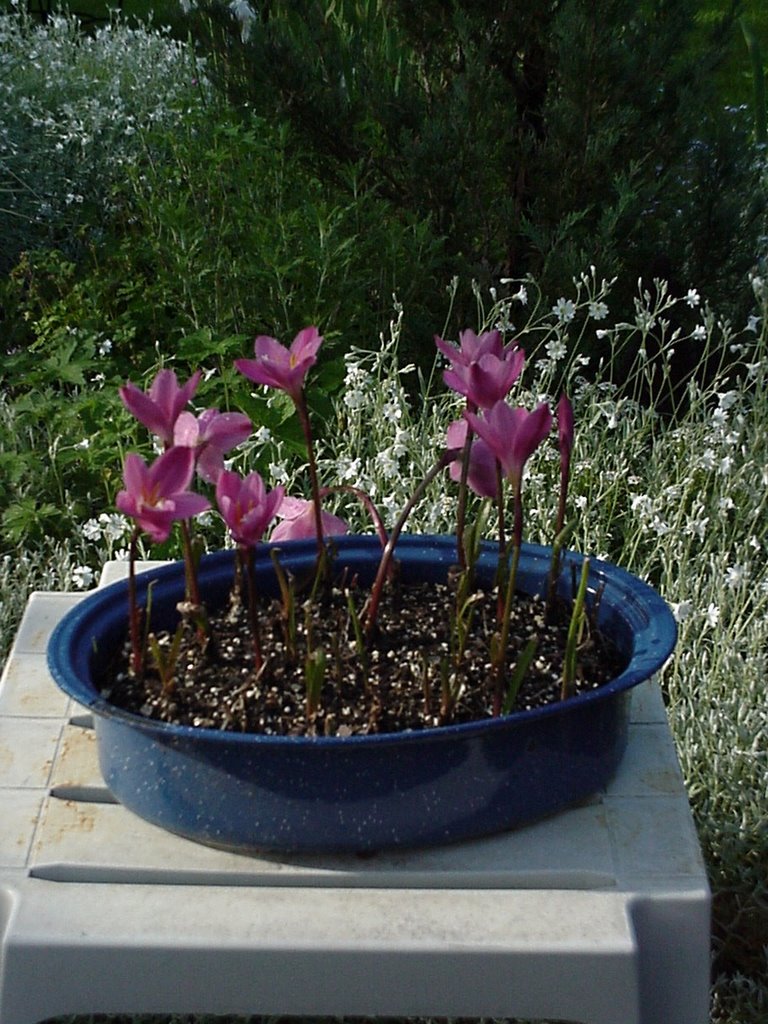
This old blue enamel roasting pan is planted with Zephyr Lilies. Going on three years now, all they ask is to be brought into frost free storage for dormancy in the winter. I got the idea for the roasting pan from some book about old fashioned plants, but someone else will have to remind me of the source, as it has slipped my mind. They are also called Fairy Lilies, or Summer Crocuses, and incidentally, the leaves will appear after the flowers.
They seem to bloom off and on all summer, most often after a good soaking. I haven't even felt bad about not repotting them, they 'll get that attention if they begin to flag. Or, I'll replace them...they are cheap and plentiful in the common rack-packages at Meijers.
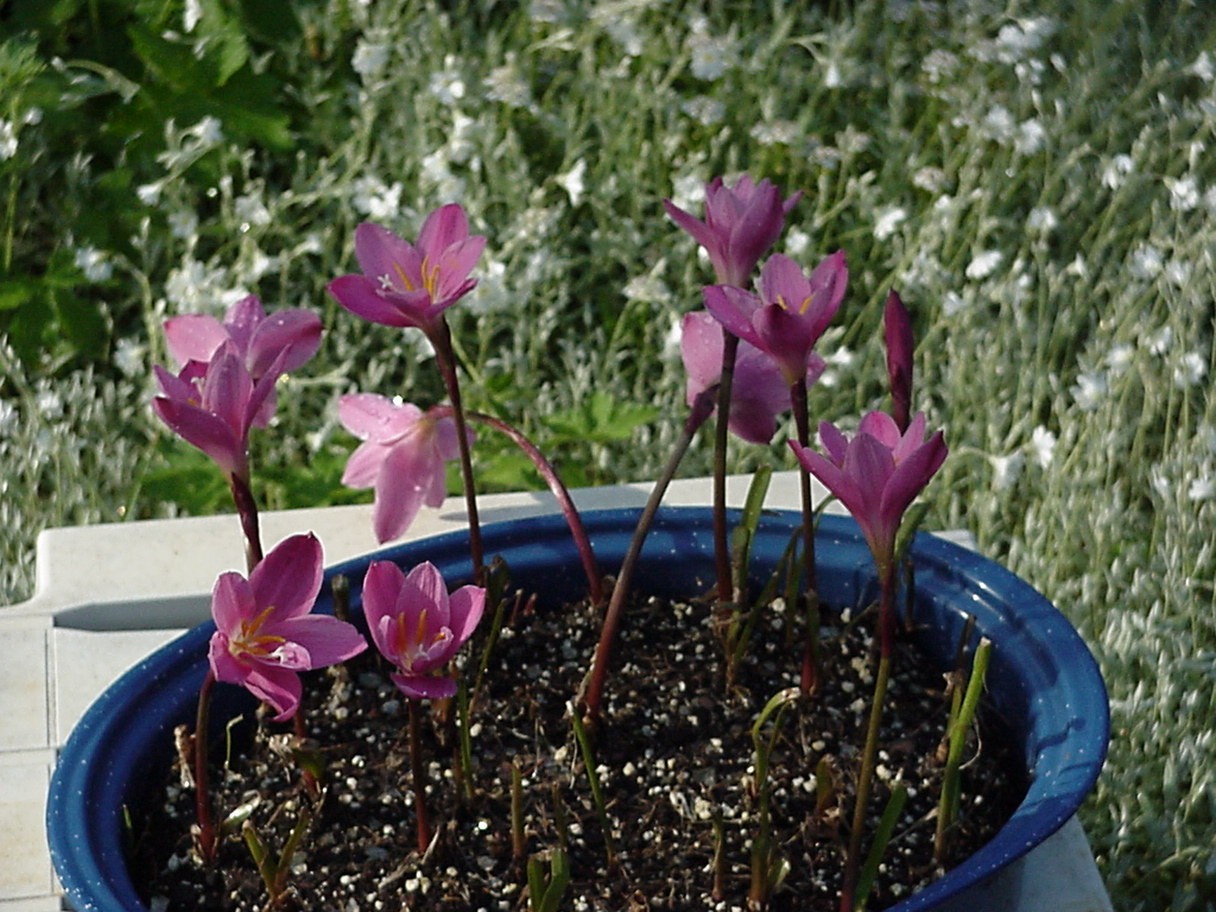
Anyway, my Zephyr lilies bloomed today, so I Googled 'Zephyr' for us all.
Zephyr, as you will remember from my Floralia story about Flora, was the Roman god of the gentle west wind who brought spring. You'll notice in a lot of the portrayals of Zephyr, he is shown with insect-type wings. That may be the fairy connection with Zephyr.
I can't copy this Victorian Rococo picture of "The Triumph of Zephyr and Flora" so you'll have to click on the link to see it: but do, it's sweet.
Anyway, my reading on Wikipedia led me to an Italian Renaissance painting called Sandro Botticelli's 'The Primavera' (1482), which means The Arrival of Spring. (In case you don't know, you can click on the photo to see it in its full size.)
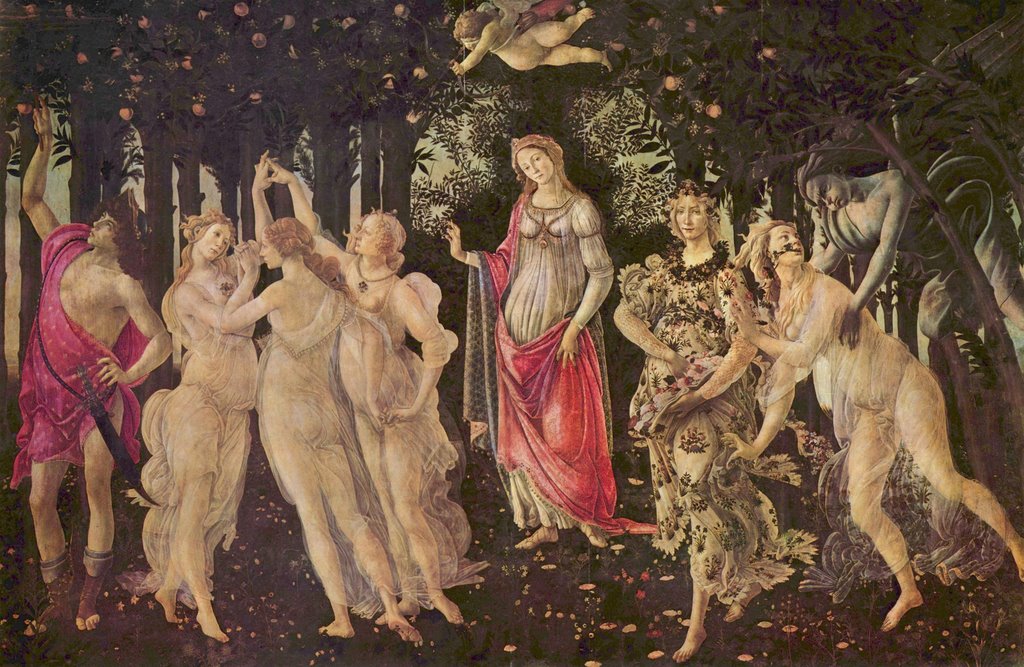
You'll notice it is along the lines of the birth of Venus picture in the Floralia story, and the story procedes along with the art...
One source for this scene is Ovid's Fasti, a poetic calendar describing Roman festivals.
For the month of May, Flora tells how she was once the nymph Chloris, and breathes out flowers as she does so.
Aroused to a fiery passion by her beauty, Zephyr, the god of the wind, follows her and forcefully takes her as his wife. Regretting his violence, he transforms her into Flora, his gift gives her a beautiful garden in which eternal spring reigns.
Botticelli is depicting two separate moments in Ovid's narrative, the erotic pursuit of Chloris by Zephyr and her subsequent transformation into Flora. This is why the clothes of the two women, who also do not appear to notice each other, are being blown in different directions.
Flora is standing next to Venus and scattering roses, the flowers of the goddess of love. In his philosophical didactic poem De Rerum Natura the classical writer Lucretius celebrated both goddesses in a single spring scene. As the passage also contains other figures in Botticelli's group, it is probably one of the main sources for the painting.
"Spring-time and Venus come,
And Venus' boy, the winged harbinger, steps on before,
And hard on Zephyr's foot-prints Mother Flora,
Sprinkling the ways before them, filleth all
With colours and with odours excellent."
The statue of Flora and Zephyr is by a French Rococo Victorian artist, Clodion.
Sabtu, 20 Mei 2006
a hen and her chicks

Grown on rooftops in Germanic and Scandinavian countries to avert lightning, ostensibly because it was sacred to the god Thor, Sempervivums are now being used as "green roof" plants.
Mine are planted in corners and niches where I want a little lagniappe of interest. This photo shows them in a chicken shaped wire egg basket with a broken crockery chicken stuck in the top where the mother plant died last year after blooming and sending out her chicks.
This link is to is another website concerning these easy favorites and other succulents. Here is a "copy and paste" snippet:
CRASSULACEAE IN ANCIENT ROME:
Crassulaceae were indeed cultivated in antiquity, but only a few. This family usually grows in regions with consistent higher temperatures and no frost in winter. Nevertheless there are some genera which are native in the area of ancient rome and greece.
THE reference for plants in ancient rome is 'Naturalis Historiae' by Pliny the Elder (C. Plinii Secundi).
In his books he describes hundreds of plants in use during his time, mostly medicinal and agricultural plants. The crassulaceae described by Pliny had mostly medicinal uses, but also mythological.
The Sempervivum was planted on roofs of houses to protect the house against lightning. The plants of this genus were considered sacred to Jupiter in Roman and to Thor in Teutonic mythology.
Jupiter and Thor were associated with thunderbolts - it is said their beard can be seen in the flowers, hence the Romans also called it 'Jupiter's Beard' (Jovis Barbam). It was also cultivated in pots and beds in roman gardens.
This habit is not as far fetched as one might think - todays science has an explanation:
Due the acute (pointed) leaves, the equalisation of the electrical charge between the house and the air is eased, therefore the chance of a spark discharge is lowered. Sure this effect might be tiny, but in case of a lightning bolt it can be essential if it discharges or not.
Sempervivums are known as rosette-leaf succulents. It's latin name splits up into Semper - always and vivum - living. We commonly know the Sempervivum as houseleek, 'Hen and Chicks' or Jupiter's Beard.
All plants of this genus are more or less cold-hardy. They are native to central and southern Europe, the islands of the Mediterranean and northern Africa. Furthermore they grow in regions at sea-level, but also in alpine regions.
The myth of the protective feature for house was adopted in medieval times and was documented in Charlemagne's (Karl der Große) "capitulare de villis":
§70: [...] Et ille hortulanus habeat super domum suam Iovis barbam. [...]
"And there the gardener ought to have the 'Iovis barbam' over his own house."
Sempervivum as medicine:
The roman-greek scholar Dioscorides (Dioskurides) (~40-~90AD) mentioned the sempervivum in his work 'De materia medica' and recommended crushed leaves with wine to get rid of intestinal parasites. Mashed leaved were also used to treat burns and scalds. Cut leaves were used against warts, calluses, corns and insect stings - the juice was used to treat shingles and earache.
'Naturalis Historiae' by Pliny the Elder is by far the best reference for uses of the Sempervivum. In countless passages he mentions the Sempervivum against articular gout, diarrhea, worms, stomach pain and more. The usage was either internal (juice), rubbing on the area of pain or simply applying parts of the plant on the body.
Pliny uses several names for one species, but comparisons with other ancient authors lead to a certainty for attributing to modern species names.
Sempervivum
Pliny sci-name common name
aeizoon Sempervivum aizoon (Bolle) Christ. Hauswurz; houseleek
aizoum Sempervivum tectorum L.
sedum Sempervivum L. Eigentliche Hauswurz; houseleek
Other common names: Houseleek, Jupiter's Eye, Jupiter's Beard, Thor's Beard, Bullock's Eye, Sengreen, Ayron, Ayegreen, Donnersbart
[preliminary version]
© 2003 Captain
last modified: 11-JUN-2003
Jumat, 28 April 2006
Happy Floralia

The Floralia, also known as the Florifertum, was an ancient Roman festival dedicated to the goddess Flora. It was held in late April through early May and symbolized the renewal of the cycle of life, marked with dancing, drinking, and flowers. The Floralia was on the IV Kalends May. While flowers decked the temples, Roman citizens wore colorful clothing instead of the usual white, and offerings were made of milk and honey to Flora.
In Roman mythology, Flora was a goddess of flowers and the season of spring. While she was otherwise a relatively minor figure in Roman mythology, being one among several fertility goddesses, her association with the spring gave her particular importance at the coming of springtime. Her festival, the Floralia, was held in April or early May and symbolized the renewal of the cycle of life, marked with dancing, drinking, and flowers. Dedicated to Flora, the goddess of flowers and vegetation, this day was considered by the prostitutes of Rome to be their own. Her Greek equivalent was Chloris.
Flora was married to Favonius, the wind god. Due to her association with plants, her name in modern English also means plant life. Flora achieved more prominence in the neo-pagan revival of Antiquity among Renaissance humanists than she had ever enjoyed in ancient Rome.
There are many stories in Greek mythology about figures named Chloris ("Khloris" or "Khloros" meaning "greenish-yellow", "pale green", "pale", "pallid" or "fresh"). Some clearly refer to different characters; other stories may refer to the same Chloris, but disagree on details.
Chloris was a Nymph associated with spring, flowers and new growth. She was abducted by (and later married to) Zephyrus, the west wind, who gave her dominion over spring. Together they had a son, Carpus. Carpus means "fruit" in Ancient Greek, and the natural metaphor formed by the three can be seen in the following quote: "Zephyros... the personification of the West Wind which brings with it freshness and rain in the spring. He would unite with Chloris, goddess of the new vegetation, from which sprout the fresh fruits of the soil."
Chloris's festival, Floralia, was celebrated on April 28 to May 1 until the 4th century.
Langganan:
Postingan (Atom)