Tampilkan postingan dengan label celebration. Tampilkan semua postingan

Senin, 18 Februari 2008

A birthday scrapbook

A good find I stumbled on: Smilebox dot com, an easy digital scrapbooking site that's free or you can purchase more features.
Enjoy a few scenes from Kayla's birthday...
Click to play A birthday scrapbook
Create your own scrapbook - Powered by Smilebox
Make a scrapbook - it's easy!

Senin, 26 November 2007

turkey'd out - with a heritage turkey

Yep, three nights of eating leftover turkey does the trick. I'm turkeyed out.
The holiday was good, most of our local family made it, and Patrick's absence will only serve to remind us all to press him more insistently to come home next year.
The mashed potatoes just weren't the same.
Ah well, he already has his plane ticket to come home for Christmas.

But I did want to tell you about our turkey this year. We inadvertently had a Barbara Kingsolver Thanksgiving, a la her fine book, Animal Vegetable, Miracle, which I read this summer, at the time never thinking I'd have the chance to buy a heritage turkey for our table.

But a few weeks ago I was at a centennial farm in the neighborhood, buying some straw bales to use in my garden, and the subject of turkeys came up. I saw some turkeys in a wire pen in a side yard, and some more 'pet' turkeys running around in the backyard, and asked the owner if turkeys were as dumb as people say (no)... and we got into a conversation.

The family had been tossing around some ideas, CSA farming for one, and my enthusiasm got me on their call list in case they decided to harvest their birds. So I got the call!

Bring a cooler and a check, and the fresh homegrown and local turkey was mine:)
(I'm sorry about that happy face emoticon, I do them in e-mail, and it somehow just fits, although I know they are a dumb substitute for what I should be doing here, words.)

These turkeys were raised by this farm family from eggs, and kept in a large moveable pen to give them the nutrition, cleanliness, and mental health of free birds. (I know, 'sing Free Bird', hehe.)

Weeds, as every herbie knows, are chock full of nutrition. Mixed weeds have the goodness of deep green, and their diversity brings each weed's uniquely healthful qualities to the turkey that consumes it, and by that path, to our plates.
Same for the little bugs that the turkeys consume in their pecking. The ground that the pen laid on the previous week is pecked clean and naturally fertilized. And the birds are protected with fencing from the devestation of fox, coyote, and running into the road.
The moveable pen idea is a good one - I think it's called a "tractor" in some circles, as in 'chicken tractors', you can google it.

The farmer, Ginny, was quite interested in cooking methods; she suspected that these birds might be too different from what we are used to eating, and the preparation might be an issue. As with most animals who get exercise, the muscles are darker and more flavorful. She'd done some research and gave me a printed out recipe I can, through the wonders of the internet, share with you now:
http://heritageturkeyfoundation.org/articles/Turkey%20Article%2005.htm

Now Ginny can rest assured, our turkey was delicious! But it was a little different from the butcher shop Amish fresh turkey that I usually buy.

The shape - it was long, pointy and svelte! I was expecting to feed 10 adults, and the turkey was only 12.3 pounds, so I bought a back up turkey breast (see above). But we never had to even slice into the backup bird. I sent sandwich material home with Skip and Tree.
I had to roast the birds in the oven, not the roaster I had planned on and the legs hung over the side of the pan. When I was making stock later, I noticed the leg bones and breast bone were noticeably longer than any turkey bones I'd ever seen!

RECIPE: Roasted Heritage Turkey

My roasting method was to put the unstuffed bird on a rack over a pan, breast side down, and start it in the oven at 475 degrees, turning it down to 260 degrees after a half an hour. Altogether the roasting time was 4 hours for our 12 lb. bird.
Before roasting, I crammed the cavity with handfuls of freshly cut parsley, sage and rosemary, and an onion, and "larded" the top with four large strips of good bacon, and never had to do another thing.
The pan-drippings made great gravy and the stock was excellent.

Anyway, I read a nice quotation a few days before Thanksgiving that I'd like to underline here:

"The company makes the meal."

The turkey was good and worth remembering, but the family, going out of their way to be together, is the best part of Thanksgiving.

Selasa, 01 Mei 2007

Happy May Day

Charming people celebrating Spring.

Garland Day

The Maypole Dance

and Morris Dancers

"A little madness in the spring
is wholesome even for the king."
-- Emily Dickenson

Rabu, 24 Januari 2007

For Robert Burns

His birthday is tomorrow.

Selkirk Grace

Some hae meat and cannot eat.
Some cannot eat that want it:
But we hae meat and we can eat,
Sae let the Lord be thankit.

This following Burns Supper Format I copied from the official Burns Supper website where you can find the recipes and a sample of Burns poetry.

Just thinking, the Cock-a-Leekie soup is pretty similar to the Leek and Potato Soup recipe that Norma posted in the GCHS Yahoo Group that she served at the January meeting. I'm thinking of making it for dinner tomorrow night. I'll have to call mine Turk-a-Leekie though, as I'm out of frozen chicken broth and will be using my frozen turkey broth instead. I don't think any true Scotsman would decry the substitution, thriftiness being a virtue.

Burns Suppers have been part of Scottish culture for about 200 years as a means of commemorating our best loved bard. And when Burns immortalised haggis in verse he created a central link that is maintained to this day.

The ritual was started by close friends of Burns a few years after his death in 1796 as a tribute to his memory. The basic format for the evening has remained unchanged since that time and begins when the chairman invites the company to receive the haggis.

THE FORMAT FOR A BURNS SUPPER

Chairperson's opening address

A few welcoming words start the evening and the meal commences with the Selkirk Grace

The company are asked to stand to receive the haggis. A piper then leads the chef, carrying the haggis to the top table, while the guests accompany them with a slow handclap. The chairman or invited guest then recites Burns' famous poem To A Haggis, with great enthusiasm. When he reaches the line 'an cut you up wi' ready slight', he cuts open the haggis with a sharp knife.

It's customary for the company to applaud the speaker then stand and toast the haggis with a glass of whisky.

The company will then dine. A typical Bill o' Fare would be:

Cock-a-leekie soup
*
Haggis warm reeking, rich wi' Champit Tatties, Bashed Neeps
*
Tyspy Laird (sherry trifle)
*
A Tassie o' coffee

The Immortal Memory

One of the central features of the evening. An invited guest is asked to give a short speech on Burns. There are many different types of Immortal Memory speeches, from light-hearted to literary, but the aim is the same - to outline the greatness and relevance of the poet today.

Toast To The Lasses

The main speech is followed by a more light-hearted address to the women in the audience. Originally this was a thank you to the ladies for preparing the food and a time to toast the 'lasses' in Burns' life. The tone should be witty, but never offensive, and should always end on a concilliatory note.

Response

The turn of the lasses to detail men's foibles. Again, should be humorous but not insulting.

Poem and Songs

Once the speeches are complete the evening continues with songs and poems. These should be a good variety to fully show the different moods of Burns muse. Favourites for recitations are Tam o' Shanter, Address to the Unco Guid, To A Mouse and Holy Willie's Prayer.

The evening will culminate with the company standing, linking hands and singing Auld Lang Syne to conclude the programme.

Kamis, 25 Mei 2006

Primavera


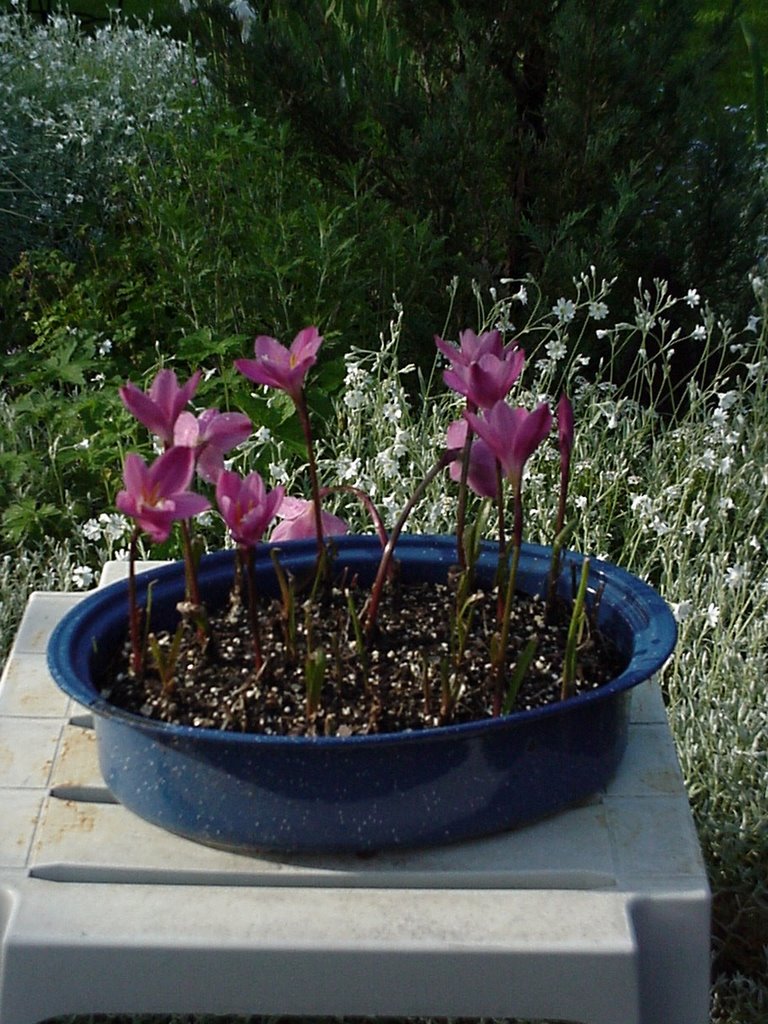
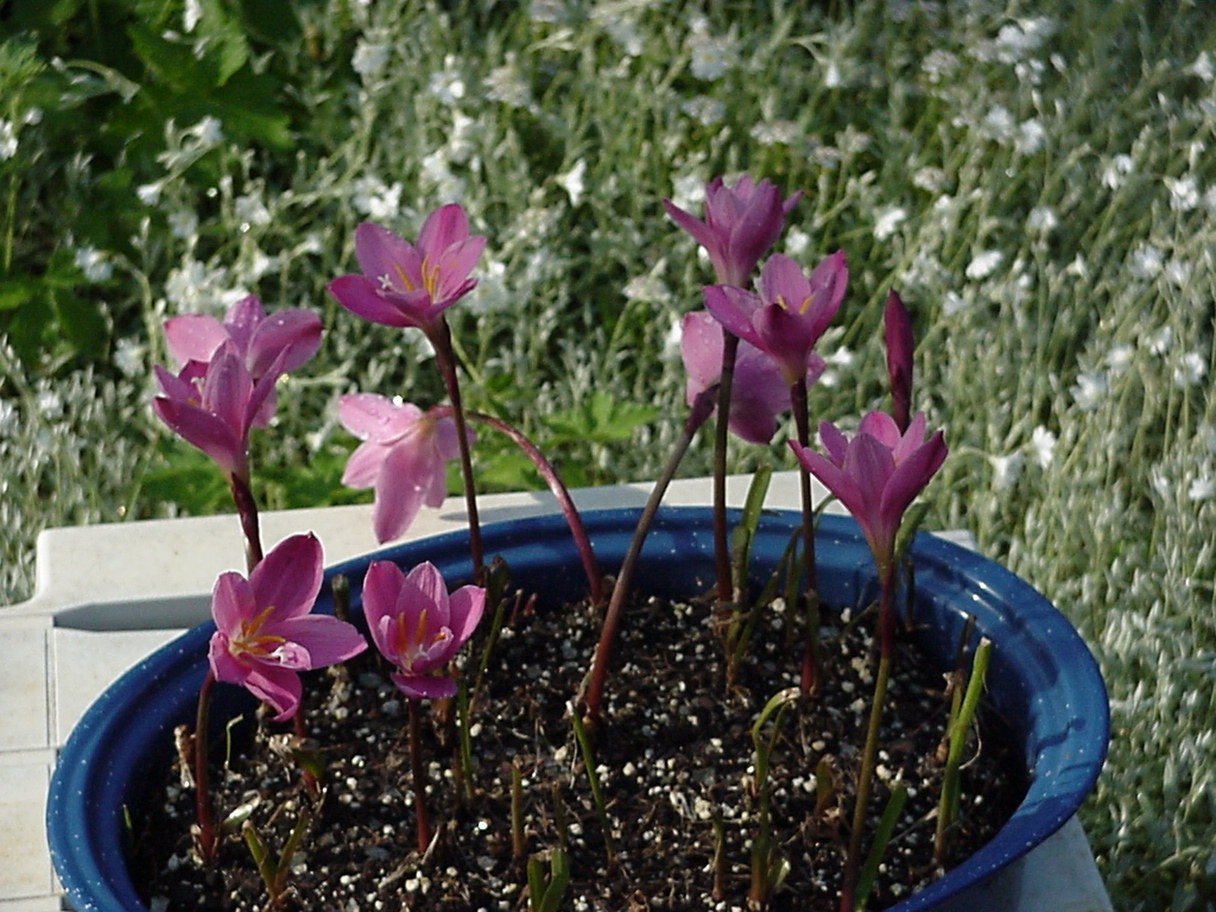
This old blue enamel roasting pan is planted with Zephyr Lilies. Going on three years now, all they ask is to be brought into frost free storage for dormancy in the winter. I got the idea for the roasting pan from some book about old fashioned plants, but someone else will have to remind me of the source, as it has slipped my mind. They are also called Fairy Lilies, or Summer Crocuses, and incidentally, the leaves will appear after the flowers.
They seem to bloom off and on all summer, most often after a good soaking. I haven't even felt bad about not repotting them, they 'll get that attention if they begin to flag. Or, I'll replace them...they are cheap and plentiful in the common rack-packages at Meijers.


Anyway, my Zephyr lilies bloomed today, so I Googled 'Zephyr' for us all.
Zephyr, as you will remember from my Floralia story about Flora, was the Roman god of the gentle west wind who brought spring. You'll notice in a lot of the portrayals of Zephyr, he is shown with insect-type wings. That may be the fairy connection with Zephyr.
I can't copy this Victorian Rococo picture of "The Triumph of Zephyr and Flora" so you'll have to click on the link to see it: but do, it's sweet.


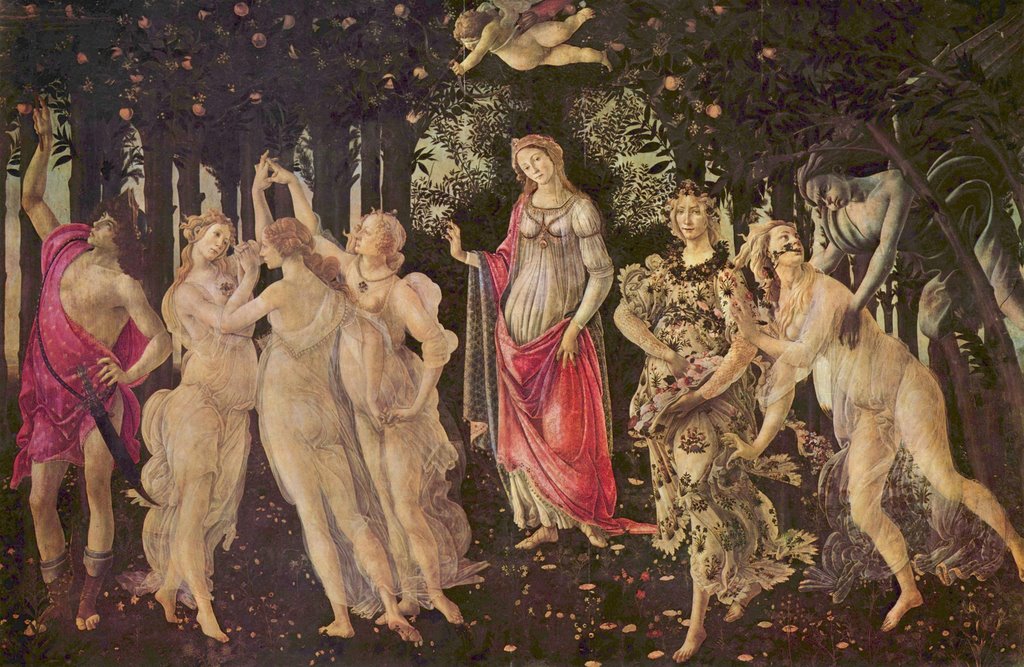
Anyway, my reading on Wikipedia led me to an Italian Renaissance painting called Sandro Botticelli's 'The Primavera' (1482), which means The Arrival of Spring. (In case you don't know, you can click on the photo to see it in its full size.)

You'll notice it is along the lines of the birth of Venus picture in the Floralia story, and the story procedes along with the art...

One source for this scene is Ovid's Fasti, a poetic calendar describing Roman festivals.
For the month of May, Flora tells how she was once the nymph Chloris, and breathes out flowers as she does so.
Aroused to a fiery passion by her beauty, Zephyr, the god of the wind, follows her and forcefully takes her as his wife. Regretting his violence, he transforms her into Flora, his gift gives her a beautiful garden in which eternal spring reigns.

Botticelli is depicting two separate moments in Ovid's narrative, the erotic pursuit of Chloris by Zephyr and her subsequent transformation into Flora. This is why the clothes of the two women, who also do not appear to notice each other, are being blown in different directions.

Flora is standing next to Venus and scattering roses, the flowers of the goddess of love. In his philosophical didactic poem De Rerum Natura the classical writer Lucretius celebrated both goddesses in a single spring scene. As the passage also contains other figures in Botticelli's group, it is probably one of the main sources for the painting.

"Spring-time and Venus come,
And Venus' boy, the winged harbinger, steps on before,
And hard on Zephyr's foot-prints Mother Flora,
Sprinkling the ways before them, filleth all
With colours and with odours excellent."


The statue of Flora and Zephyr is by a French Rococo Victorian artist, Clodion.

Jumat, 28 April 2006

Happy Floralia


The Floralia, also known as the Florifertum, was an ancient Roman festival dedicated to the goddess Flora. It was held in late April through early May and symbolized the renewal of the cycle of life, marked with dancing, drinking, and flowers. The Floralia was on the IV Kalends May. While flowers decked the temples, Roman citizens wore colorful clothing instead of the usual white, and offerings were made of milk and honey to Flora.

In Roman mythology, Flora was a goddess of flowers and the season of spring. While she was otherwise a relatively minor figure in Roman mythology, being one among several fertility goddesses, her association with the spring gave her particular importance at the coming of springtime. Her festival, the Floralia, was held in April or early May and symbolized the renewal of the cycle of life, marked with dancing, drinking, and flowers. Dedicated to Flora, the goddess of flowers and vegetation, this day was considered by the prostitutes of Rome to be their own. Her Greek equivalent was Chloris.
Flora was married to Favonius, the wind god. Due to her association with plants, her name in modern English also means plant life. Flora achieved more prominence in the neo-pagan revival of Antiquity among Renaissance humanists than she had ever enjoyed in ancient Rome.

There are many stories in Greek mythology about figures named Chloris ("Khloris" or "Khloros" meaning "greenish-yellow", "pale green", "pale", "pallid" or "fresh"). Some clearly refer to different characters; other stories may refer to the same Chloris, but disagree on details.
Chloris was a Nymph associated with spring, flowers and new growth. She was abducted by (and later married to) Zephyrus, the west wind, who gave her dominion over spring. Together they had a son, Carpus. Carpus means "fruit" in Ancient Greek, and the natural metaphor formed by the three can be seen in the following quote: "Zephyros... the personification of the West Wind which brings with it freshness and rain in the spring. He would unite with Chloris, goddess of the new vegetation, from which sprout the fresh fruits of the soil."

Chloris's festival, Floralia, was celebrated on April 28 to May 1 until the 4th century.