Minggu, 08 Mei 2011

2011 Landis Valley Herb Faire


This little clip shows about 1/10th of the actual festival.
It is always a very enjoyable festival, and this year didn't disappoint us. We helped out at Kathy Musser's Cloverleaf Herb Farm booth, but I'm not sure how much help we really were. There were so many friends to talk to! The herb festivals always make me feel like we were all in hibernation and we are waking up and getting out and greeting each other for the first time in a long time.
The staff at Landis Valley does an amazing job of putting together this faire. The Heirloom Seed Project that is part of what the museum at Landis Valley does benefits from faire, but I'm not sure that anyone really recognizes what the faire has done for this region and the herbies residing and doing business here. The herbal community here is rich and varied. We are very fortunate.
The grounds of Landis Valley are a perfect backdrop for this type of event. Various period buildings have been moved to this location, creating a village with a blacksmith shop, a general store, an inn, a fire company, several barns, and various houses (among other things).
There is some farming done and it is done in the manner of the period. The work animals are enormous oxen and drought horses. There is a feeling of peace and quiet beneath all of the activity.
At opening time on Friday morning, there is just about any herb plant or product one could desire. By noon, many of the more unusual or most sought after things are sold out. This means that Friday morning brings out the serious herb shopper. Saturday is much more mellow and laid-back.
There is so much to see and do there. There are plantings around the farmstead like this celandine used for dyeing... or this large horseradish patch.
Personally, I got to talk to about 100 great herbie friends over the last two days and had a ball. Some "ghosts" from the past even came out to visit :-).
I made several purchases. My favorite (by far!) is this persimmon tree. It is already in the ground and happily snuggled into its new home.
If you are ever in Lancaster County over the weekend of Mother's Day, do not miss this herbal event!

Jumat, 06 Mei 2011

Getting Closer to the Big Day!

Last September I was lucky enough to go to Open Garden Days at Jekka's Herb Farm in Bristol, England and meet these two lovely ladies.  On the left is Jekka's daughter, Hannah and, of course, Jekka.  We are getting closer to when Jekka will be visiting Pittsburgh and speaking to the Herb Society of America on June 24.  I just received Jekka's latest newsletter and I spotted her new blog.  Well, when I visited last year, she mentioned me in her September blog.  It took me until now to spot it!  Her new blog talks about chives and that's what my upcoming guest blog for The Herb Companion will be about next week.   GMTA, herbally speaking!  Stay tuned.  Got to get outside and walk before it rains again.  Horseradish jelly didn't gel like last time!  Going to experiment when I come back with a solution.  Keep your fingers crossed it works!  Talk to you later.

Kamis, 05 Mei 2011

Blend up some herbal tea.

In my first spring and summer of seriously learning about foraging and wild crafting, I made a wonderful tea blend. While wandering through field, stream, woods, and mountainside, I would gather handfuls of different plants. After researching to be sure of their identity and properties, they would be dried on a screen and added to a large glass jar.

Now this particular jar of tea was truly wonderful. There were the usual suspects, of course ….peppermint, chamomile, and leaves from strawberry and red raspberry. As the herb garden grew, a few leaves of sage, a sprig or two of thyme, basil, rosemary, lemon balm, lemon verbena, and comfrey found their way into the jar. Violets and their foliage went in, as did the beautiful wild roses, elderflower and honeysuckle blossoms. As the bee balm began to bloom, a few heads were dried for the tea jar. Dried nettles and cleavers and Echinacea leaves became part of the tea, and then some wonderful spices – star anise, ginger root, cardamom seed, cinnamon bark. Mid summer, raspberries, elderberries and blueberries were added along with gooseberry leaves. In the late part of the summer, I found and added rose hips.

Eventually I wound up with a gallon jar of really gorgeous dried botanicals. Each cup was completely different- in color, flavor, and scent. We had stevia and licorice root sticks on hand for sweetening, and for that winter, friends visiting our home would look forward to a cup of that special tea – always a surprise, always delicious.

It was great fun creating that blend, and it was also a time of learning. By the end of that year, it was clear that it is very difficult to make a bad cup of herbal tea, and “simple” to make a fabulous blend.
The purpose of telling this story is to encourage you to try making some blends of your own. Making teas with herbs has always been a part of the human culture. The folkloric use of herb teas is easy to find, and in this part of the country, still passed on from mother to daughter. Peppermint tea for upset stomachs, catnip and fennel to help the nursing mother, valerian root tea for sleeplessness, horehound or mullein for coughs, feverfew for migraines, sage tea for night sweats, ginger tea for morning sickness, slippery elm bark or marshmallow root for any digestive problem from lips to anus, chamomile for just about anything, St. John’s wort for the blues, and the list goes on and on. We used these plants for centuries. Now there are warnings and issues of drug interactions and this or that might be a carcinogen. Comfrey is a wonderful healing plant, but it is labeled as dangerous – the active ingredient allantoin may cause tumors in lab rats if taken in huge quantities. Ephedra was almost magical in helping people with asthma, but it has now been removed from shelves because some people used it to create an amphetamine-like product. Kava will probably be next. St John’s wort is hanging in there for now, but use is discouraged because it will interact with some pharmaceuticals. So does grapefruit, by the way….. Our advice? Use all things in moderation.

This article is an excerpt from:
available from The Essential Herbal website, under "Books" and it was written by yours truly.

Rabu, 04 Mei 2011

Please Keep Her in Your Thoughts and Prayers!

I just realized I had a photo on my new computer of Deana and me when The Herbal Husband and I took her out to celebrate becoming a registered architect to the Grand Concourse.  We had the best time that night.  I made her a tussie mussie.  Today's not only May 5th (I know I posted this yesterday), but it's Deana's birthday.  Happy, happy birthday, Deana.  Everyone who reads my blog is praying and hoping that you get better soon.

We learned late last night that our dear friend, Deana, has been diagnosed with multiple myeloma, cancer of the plasma cells!  The Herbal Husband worked with Deana at a downtown architectural firm and they became fast friends.  If anyone can beat this disease, it's Deana.  She's a Texas Aggie, first and foremost!  She has the loving and powerful support of family and friends.  This disease is going to have to fight us all, including Deana's mother and two sisters and her husband's family as well.  We are only sending positive energy!  We consider ourselves adopted by her family and we have enjoyed being with them on all occasions.  Her youngest son just turned 2 and her oldest son will be 12 and her daughter will be 8.  Deana is a young vibrant woman who wants to live for her family and friends.

This disease recently took the life of Geraldine Ferraro.  We refuse to believe that Deana will be nothing short of a miracle in her treatment.  She has already started at the Hillman Cancer Center here in Pittsburgh.  To get a second opinion (which insurance would not cover) would have cost $35,000.  Something is wrong here, people, but I'm not going to get negative!  Please keep Deana in your thoughts and prayers!

Pretty soggy in the 'Burgh.  We have had over an inch of rain in the last three days.  Got to run and make some more horseradish jelly.  Talk to you later.

Senin, 02 Mei 2011

A Small Herbal Move!

My photos are all looking alike these days!  This is one of several lady's mantles (Alchemilla mollis) that we have moved into the herb garden.  It is about twice its size already from all of the rain we are having.  A native of northern Europe and named for the Virgin Mary's cloak with the scalloped edge.  It is lovely after a rain when its leaves hold the water making them glisten.  It does have an edible flower.  I have never personally eaten it.  Ours usually get buried in a bed in the back.  Maybe now that we have moved them to a more prominent space, I will try eating some of them.  Lady's Mantle is very popular in England where it is used in an herb garden or any garden as an edging plant.  It is a clumper and reseeds very gently.  It does get ratty in the summer meaning you need to trim it back after the flowers are done to have it looking good.  A very ornamental herb.  Hope you had a good day wherever you may be.  Talk to you later.

Minggu, 01 Mei 2011

Making Herbal Meads: St. John's Wort and Cherry Mead


This post is part of a Wild Things Round Up. Interested in homemade elixirs, beers and other wild and crazy alcohol treats? Check out the entire listing here. 


Yesterday my husband and I bottled up the last of our wines. All of the batches turned out pretty well, but it was the St. John's Wort and Cherry mead that was the most spectacular. Light and floral and the color of a beautiful rosé. 


So, of course, I had to brag about this on my Facebook page and in response I had numerous requests for the recipe. So here you are!


For now, bookmark this page to make your own St. John's Wort and Cherry mead this summer. 


If you’ve never made mead or wine before look for my how-to video on making dandelion wine on YouTube.com. 


To make this recipe I used St. John's Wort Flowers that had been frozen for about a month. I've never used dried St. John's Wort Flowers so I can't comment on whether or not that would work. 


Thanks to Portland herbalist Missy Rohs for giving me the idea! 


St. John’s Wort and Cherry Mead
Ingredients
One gallon of water
3 pounds of honey
1/4 teaspoon of yeast nutrient
One gallon of fresh St. John’s Wort Flowers
One pound of cherries (de-stoned and crushed)
1/4 cup of lemon juice
Wine yeast


  1. Place the honey and water in a pan and bring to a boil.
  2. In a food-grade bucket add the St. John’s Wort Flowers, cherries, lemon juice, and yeast nutrient. 
  3. Pour the just boiled honey water into the bucket and stir well. 
  4. Once the mixture in the bucket has cooled to about 85 degrees F, add the wine yeast (follow the directions on the wine yeast packet). Stir well. Cover with a cloth.
  5. This will stay in the primary fermenter for 3-5 days. Each day stir the mixture well. 
  6. After 3-5 days in the primary fermenter, strain off the liquid and place it in a carboy with an airlock. It will be ready in a year.


    Update: This is one of my favorite meads ever! I highly recommend the recipe. This year we made another batch and this time we simmered the cherries along with the St. John's Wort. We'll have to wait another year to find out how it compares. 


Sabtu, 30 April 2011

X Gardening in the High Country of Colorado


At The Essential Herbal this issue (May/June) we were thrilled to not only get an amazing cornucopia of articles that caused us to add extra pages, but Kristie Nackord of Spirit Horse Herbals sent this article with gorgeous pictures that we wanted to share with you here.

Growing Medicinal Herbs in the High Country

We call it X-Gardening!

Warning… it’s not for the faint of heart.

Sure, doing back flips on a snow board, jumping out of airplanes, or screeching around on a skateboard up and down half pipes can be thrilling indeed! But for me, nothing compares to the Extreme Gardening experience of growing herbs at 8300 feet in the Rocky Mountains of Colorado! With a cool growing season of 90-days or less, coupled with mid-summer hail storms, unexpected freezes, and gale force wind, nothing keeps me on my ‘growing toe’s more than Mother Nature herself.

The good news is you can live in the majestic mountains and still successfully grow herbs. In fact, there are many inexpensive and sustainable techniques you can utilize to extend your season and protect your plants to produce a bounty of highly potent and nutritious herbs each year.

Site Selection: Proper site selection applies to whether you live at sea level or in the mountains of Colorado.
Place your shade loving plants in the shade and place those sun worshipers, well, in the sun! For those plants that like to take over the world, place them in their own designated area where they can’t encroach on other plants, or put them in containers. Here in the high country there are very few plants I have to do that with but there are some like stinging nettles and any members of the mint family including lemon balm that I am mindful with.

Plant Selection: Bottom line is that I grow fast growing herbs that like it cool, high and dry. I’ve got a 90-day window to grow within, so when I am choosing plants or seeds I am always careful to select varieties that fall within these requirements and that are hardy to zone 3. Most importantly, find a local seed lending library or purchase your plants and seeds from companies that offer varieties that are already adapted for the high country. For example, I grow a variety of basil sold by Seeds Trust called Italian Mountain Basil. It is a fast growing variety that comes from the mountains of northern Italy that is more tolerant of cold climates. Some of my other all time favorites that thrive in the high country include: Calendula, Cilantro, Thyme, Motherwort, Mugwort, Self Heal, Arnica, Borage, Nasturtium, Bee Balm, Stinging Nettles, Chamomile, Dandelion, Mullein, Red Clover, Alfalfa, and Comfrey. Sadly, this does not include tropical loving or temperate loving herbs such as lavender, rosemary, lemon grass or passion flower. You can grow these beauties as annuals or if you have cover such as a greenhouse.

Grow bio-intensively: This is THE key for growing herbs successfully in the mountains. Originally developed by Alan Chadwick in the 70’s and now evolved by John Jeavons, growing bio-intensively has many benefits. By double digging your beds two feet deep and spacing your plants equidistantly, you are able to pack in 2 to 3 times more plants in half the space of traditional row gardening. For numerous different reasons this method of sustainable growing offers heat and water retention and weed suppression. For more information on Growing Bio-intensively please visit John Jeavons website www.growbiointensive.org

Compost and Mulch: It’s free! And it works. In addition to compost, I use what is available to me and that also includes aged horse manure turned into my beds. For mulch on my beds or in the aisle ways of my garden, I use spoiled hay or straw and I pack it on thick. Leave room around the crown of your plant and you will be pleasantly surprised how much water retention and weed suppression this little bit of effort affords.

Cover: There are many different types of cover you can use. One of my favorites is the ‘American Bell Jar”. Also known as a plastic jug with the bottom cut off! If you have a small, tender herb that is struggling or newly transplanted, place a plastic jug over it with the lid off. Once your plant is healthy and strong attempting to burst out of the jug, remove it! Hoop houses, cold frames, and greenhouses are other forms of cover and they not only protect your plants from hail, wind, and freezes, but they also extend your season. They also allow you to grow some of your tender or heat loving herbs.

And the most important elements you can bring to your garden whether you live in the mountains, desert, or near the ocean, is love, joy, and gratitude for the miracle of creation.

Good growing to you~

Originally from northern California, Kristie is entering her fifth season growing in the high country in Westcliffe, Colorado. Kristie is the herbalicious herb girl behind Spirit Horse Herbals, a boutique producer of medicinal herbal products. www.spirithorseherbals.com


If you have enjoyed this article, The Essential Herbal is available by subscription. The print magazine will come to your door every 2 months, filled with great herbal information.

Jumat, 29 April 2011

A English Breakfast for the Prince and Princess!


Well, unlike a lot of America this morning I was asleep for the live wedding.  I did get up in time for a replay and that is all that I wanted just the highlights!  Had to have an English muffin with some pineapple sage jelly and rose petal tea in my Portmeirion Botanic Garden mug.  The egg is not quite like the English eggs, but Egg Beaters with a wedge of Laughing Cow cheese cut up in it in the microwave for a 1 minute 45 seconds.  Perfect.  So I wish their Highnesses all the best.  Hope you are having a good day.  May we keep all of the people in the south in our thoughts and prayers.

Kamis, 28 April 2011

Lots of Good Basic Herb Gardening Information!

The photo is just decoration for this post.  I wanted you to see my angelica hedge!  We actually transplanted some of it out of my herb garden!  It's going to be massive again.

I had a little herbal meltdown the other day and I've come into the herbal light and it's all good.  Sometimes we all need a little jolt and I got one.  I know some of you would like another blog on other herbal topics.  I have decided not to go there for the moment.  Do blogs ever run out of space?  Maybe.  Well, we will cross that herbal bridge when we come to it.

I'm going to lean on the great articles and wisdom of my favorite herb magazine, The Herb Companion!  If you are interested in starting an herb garden, Jim Long wrote a great article on a five-year plan for an herbal kitchen garden.  Even though it is talking about herbs and veggies (which is a great combo), the foundation of planning a garden is there.  I think the most important part of any garden, herbal or not is the location.  Herbs like at least six hours of sun a day.  More is better.  East and west are good especially in the southern and western parts of the United States.  I wrote about the Tucson Botanical Garden when we visited in 2008 and tips for growing herbs in the west.  North is the worst exposure and if you only have a northern location, you need to be growing another species of plants!  There is an article called  An Herb for Every Spot on The Herb Companion website as well and Herbs in the Southern Garden is another article that may give you helpful hints and tips on herbs if you live in the southern portion of the United States.

Also soil is very important.  It is a living and breathing foundation of your garden.  We have clay soil here in southwestern Pennsylvania.  If you are starting a whole new garden or just a new bed with herbs, I would be doing a soil test through your local county extension office.  I think just about every county in the United States has extension offices and possibly a master gardener.  Take advantage of this resource because they live in your specific area and deal with your problems day in and out.  Not every county has a master gardener program, but they should have a staff that can steer you in the right direction.  They have great publications that are written by the sponsoring extension university.  For example, our extension university is Penn State University, New York is Cornell University, Ohio is The Ohio State University, New Jersey is Rutgers University, etc

At the very least you want to be adding compost or some other kind of organic matter to loosen the clay in your soil.  Herbs require very well drained soil.  With all of the rain we are having, the Herbal Husband said to me the other day that we had a small pond in the back of my herb garden!  My herb garden isn't very big to have a small pond in the back.  So anything we plant there we will have to amend the soil with maybe some chicken grit to make it drain better.  Sometimes when you add sand to clay, you get concrete!

I would also be aware of the trees and shrubs that surround your garden space.  If they are small now, they will mature when you least want them to and possibly block out your sunlight for your herbs.  They also take nutrients away from your herbs.  Not that shade isn't a good thing especially in the south, you need morning sun and afternoon shade in that case.  See articles linked above for more information.

Here is an additional post from a follow blogger, Rhonda Fleming Hayes, about The Garden Buzz: Growing Strategies for Beginning Herb Gardeners talking about propagation for various herbs.  I found a great article on Container Gardening Essentials that will give you great basic information on growing herbs in containers.

Finally, wildlife can be an issue in all of our gardens.  The good news is that deer who love to browse trees, shrubs, annuals and perennials aren't particularly interested in herbs.  I think the smell is a big detractor.  Well, I hope this has helped you with your herb issues.  Please leave me comments or e-mail me with your other herbal concerns.  Talk to you later.

Selasa, 26 April 2011

Was A Beautiful Day to Get Outside!

We have all these quirky little paths that are a bear to mow and are full of weeds each spring.  I do take delight in pulling the wild cress (we do eat that in our salads) and creeping Charlie (ground ivy) each season.  Creeping Charlie is a real problem for homeowners who enjoy their lawns.  I have already gotten two bug bites!  I have been out even between rain showers this year.  We have had a lot of rain.  I think we are at 7 inches over for the season already!
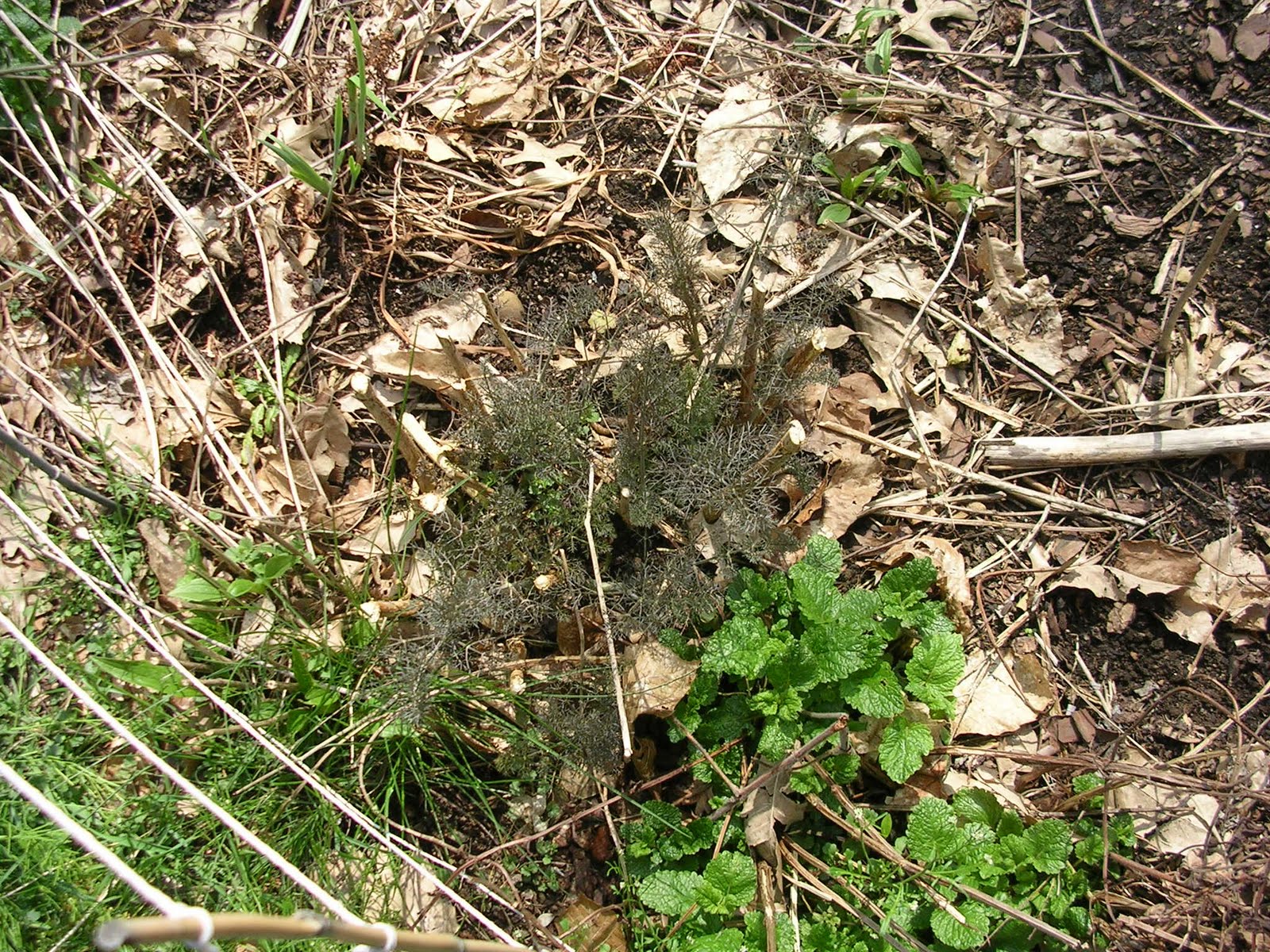
The bronze fennel is coming back, a magnet for swallowtails and the ever present lemon balm.  In some cases, I do use lemon balm as a filler like a seat filler at the Oscars!  Way off base there!  Sorry about that!
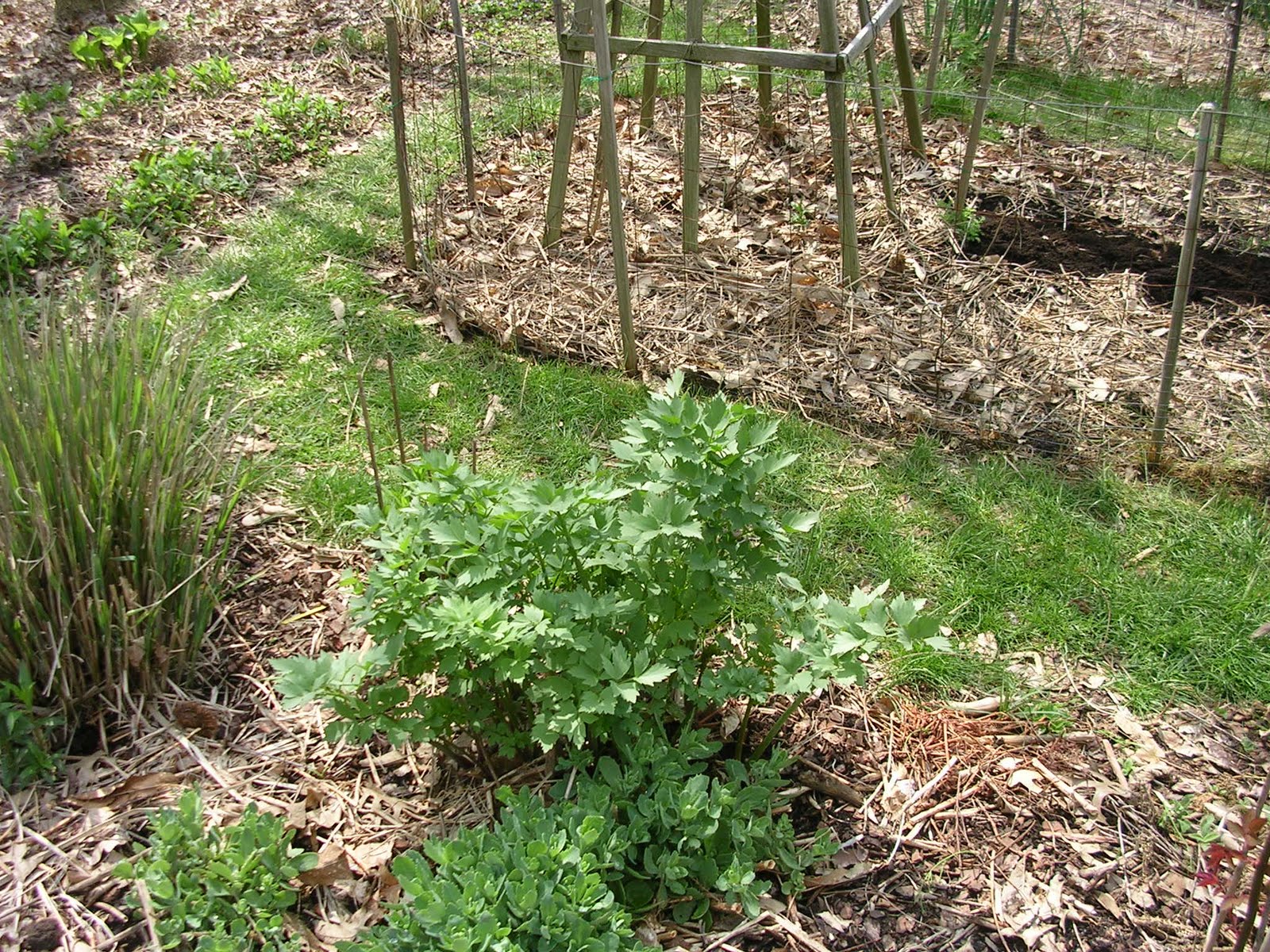
The lovage is looking good and has doubled in size since my last report.  Love, love the spring herbs in the garden.
I don't have a lemon verbena coming back in the garden.:(  I do have a curry plant (Helichrysum italicum) and it is definitely a tender perennial for us.  Just need to remember to cover it on colder nights and we will probably have some in May!  Well, I hope you have had a good day wherever you may be.  Tomorrow is Miss C's 14th birthday!  She is growing up way too fast.  I've got a special surprise for her.  I'll share it after I give it to her and it may be later in the week after her birthday.  I'll at least call and sing her a happy birthday.  Talk to you later.