Health Blog

The content of this site is anecdotal and provided for entertainment purposes only. It is not intended as medical advice. If you are ill, please see your doctor.

Rabu, 11 April 2012

The Cardiovascular System: Anatomy and Physiology from an herbalists perspective


This article is part of the Anatomy and Physiology section of www.HerbMentor.com.
In the previous anatomy and physiology section we learned the role of the respiratory system in oxygenating blood. The cardiovascular system is a continuation of that oxygenation process. The heart pumps blood through a closed system of blood vessels in order to bring oxygen and other nutrients to the cells throughout the body.
In part I of the cardiovascular system we will gain an understanding of the various parts of this system and then put these organs together to gain an understanding of how blood is circulated through the body.
In part II we will learn more about the blood itself.
The cardiovascular system consists of:
  • The heart
  • Blood vessels including arteries, capillaries, and veins
  • Blood
The Heart
The heart is a muscular organ made up of involuntary striated muscle tissue. It is located in the thoracic cavity in between the lungs and just above the diaphragm. It is covered in protective membranes called the pericardium. Besides forming a protective layer, these membranes also secrete a fluid that helps to reduce friction as tissues rub together during heart contractions.
The next layer of the heart is a thick layer of cardiac muscle tissue called the myocardium. It is the contraction of the myocardium that creates the force necessary to pump blood through the body.
Attached to the outer surface of the myocardium is the epicardium. This membrane consists of blood vessels that nourish the heart.
Blood Supply
The heart is supplied blood through the coronary arteries, which come off of the aortic artery. Blockage of the coronary artery is what causes a heart attack.
The Heart Chambers
There are four chambers in the heart. The two upper chambers are called the atria. They receive blood from the veins. The two lower chambers are the ventricles. Blood is pumped from the ventricles to the arteries and to the rest of the body. The heart consists of two pumps. The left atrium and left ventricle is the left pump. The right atrium and the right ventricle is the right pump. There is no opening between the atria or between the ventricles. Instead, there are valves in between the atria and the corresponding ventricles.
The Heart Valves
There are two types of valves located in the heart: the atrioventricular valves and the semilunar valves. The atrioventricular valves are located between each atrium and its corresponding ventricle. These valves allow blood to flow from the atrium to the ventricle without allowing any blood to flow backwards from the ventricle to the atrium. The two atrioventricular valves are the tricuspid valve and the mitral valve.
Semilunar valves are located in the arteries that carry blood from the ventricles to the rest of the body. The two semilunar valves are called the pulmonary semilunar valve and the aortic semilunar valve.
The sound we associate with the heartbeat is actually the closing of the heart valves. “Lub-dub” is the sound often used to describe the sound of the heartbeat. The first sound, “lub”, is the sound of the atrioventricular valves closing. The second sound, “dub”, is the sound of the semilunar valves. If any of the heart valves are not working correctly then another sound might be heard. This is referred to as a heart murmur.
Blood vessels
There are three main types of blood vessels. Arteries, capillaries, and veins form a system of tubes that carry blood to and from the heart. The blood vessels form an incredible network of tubes throughout the body. An adult has as many of 100,000 miles of blood vessels in their body.
Arteries
These large blood vessels are made of a thick muscular layer to withstand higher blood pressure. They carry blood from the heart to the capillaries.
Capillaries
Capillaries form a vast network of very small vessels that enable the exchange of materials between blood and the tissue cells. The term capillary bed refers to a network of capillaries that supply blood to an organ.
Veins
Veins return blood from the capillaries back to the heart. They are made up of a relatively thin muscular layer and contain internal valves to keep the blood from ever flowing backwards. About 60% of the blood volume is located in the veins at any given time.
Blood Flow
Deoxygenated blood from the body flows from the superior and inferior vena cava veins to the right atrium. This blood is pumped to the right ventricle and then proceeds to the pulmonary trunk where it is oxygenated by the act of inhalation. This newly oxygenated blood then flows through pulmonary veins to the left atrium and is pumped to the left ventricle to continue to the aorta and the rest of the body. These are referred to as the pulmonary and systemic circuits.


Pulmonary Circuit
 
Assists deoxygenated blood from the right ventricle to the lungs and then assists newly oxygenated blood from the lungs to the left atrium. (This is the flow of blood between the heart and lungs.)


Systemic Circuit
 
Assists oxygenated blood to all parts of the body (except the lungs) and then returns deoxygenated blood to the right atrium. (This is the flow of blood from the heart to the rest of the body.)

The following diagram illustrates the flow of blood. Blue indicates deoxygenated blood and red indicates oxygenated blood.
Blood Pressure
The circulation of blood throughout the body happens due to changes in blood pressure. Blood naturally flows from areas of high pressure to areas of lower pressure. When the ventricles contract it creates the pressure necessary to push the blood into the arteries. As the blood travels throughout the body the pressure continually decreases.
Blood pressure is measured in two numbers. The systolic blood pressure is the measurement of the ventricular contraction. The diastolic blood pressure is the pressure measured during a ventricular contraction. Optimal blood pressure is around 120/8
Further Resources:
General Heart Health
  • David Hoffman gives an overview in his article Herbal Therapy and the Cardiovascular System
  • A PDF of an Herbalist’s view of the Cardiovascular System by 7Song
  • Extensive amount of information about heart disease can be found here: Chris Kresser
  • Cardiac Remedies by David Hoffman
  • An article related low Vitamin D Levels to Diabetic Cardiovascular Disease by Karen Vaughn
  • CLA: The good Trans Fat by the Nourished Kitchen
Hypertension
  • A look at herbs and hypertension by Paul Bergner
  • Karen Vaughn looks at Herbs and Hypertension
Cholesterol
  • Henriette looks at Statins and Cholesterol
  • 7 Reasons to Eat More Saturated Fat
  • Vitamin D, Statins, and Red Yeast Rice by Karen Vaughn
  • I have high cholesterol and I don't care by Chris Kresser
Angina
  • An article by David Hoffman
Congestive Heart Failure
  • An article by David Hoffman
Heart Attack
  • An article by David Hoffman
Varicose Veins
  • An article by David Hoffman
  • An article by Chanchal Cabrera
Hemorrhoids
  • Henriette Kress gives an overview
Arteriosclerosis
  • David Hoffman gives an overview of Arteriosclerosis
  • Calcium supplements linked to hardening of the arteries. 
Anemia
  • Treatment guidelines from Chanchal Cabrera
Hypotension
  • An article by David Hoffman
Bruises
  • Great overview of bruises and how to treat them with herbs
Works Consulted
  • The anatomy and physiology in this article was extracted mainly from The Principles of Anatomy & Physiology, Tortora, Grabowski. I also used Anatomy and Physiology by Stanley E. Gunstream 4th ed.
  • The second half of this article giving us an herbal perspective on the nervous system would not have been possible without jim mcdonald’s Article Index. Thanks a thousand times to jim for putting this together.
This article is part of the Anatomy and Physiology section of www.HerbMentor.com.
Diposting oleh Admin di 07.46
Kirimkan Ini lewat EmailBlogThis!Bagikan ke XBerbagi ke FacebookBagikan ke Pinterest
Label: Anatomy and Physiology

Selasa, 10 April 2012

A Calendar Garden!


Almost forgot to brag a bit!  My herb garden is the bottom photo of April in the Herb Society of America calendar!  This photo is from the year we participated in the local library garden tour!  A little chilly outside but bright.  Hope you are having a great day.  Talk to you later.
Diposting oleh Admin di 09.55
Kirimkan Ini lewat EmailBlogThis!Bagikan ke XBerbagi ke FacebookBagikan ke Pinterest
Label: Lemon Verbena Lady Adventures

Senin, 09 April 2012

It Seems to be the Same Every Year, Herbally Speaking!

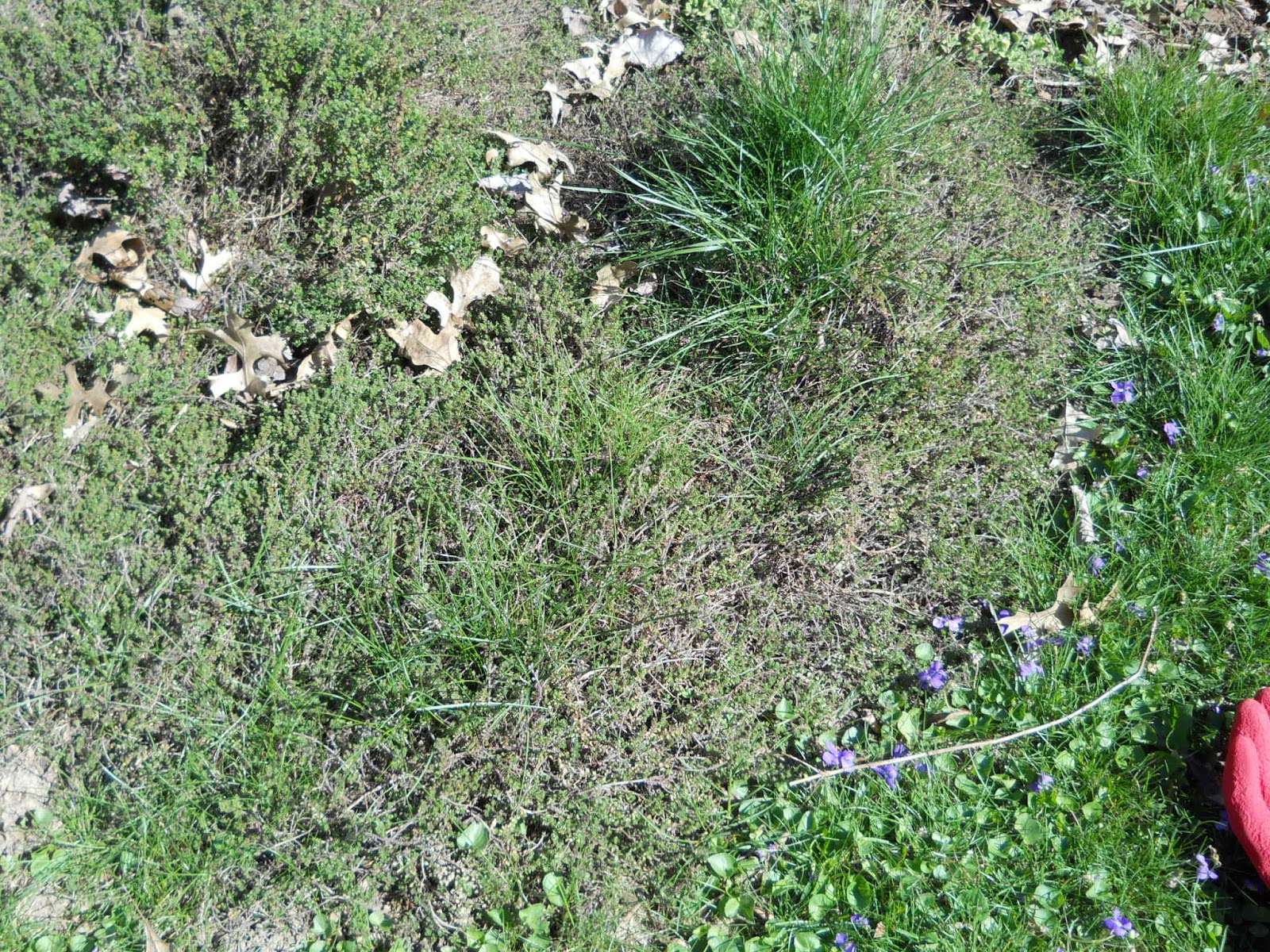
The lawn has grown up through the thyme!
A lot of the grass can be pulled out underneath!
It seems every year I'm pulling the lawn out of my lemon thyme!  This year the grass has gone crazy.  I think because we really didn't have much winter, the grass has just multiplied.  I need to pull out the tweezers to get the rest.  We are going to have a couple of cooler days with wet snow!  The weather has just been up and down like it should have been in March.  I've been working behind the scenes on a couple of lists, one of annual herbs for your garden and the other of tender perennials.  I hope you have noticed that I have moved the Perennial Herb List I did to a permanent page under my banner page.  I will make additional pages for each of the lists I'm working on now.  I have also been working on a post for Herb Companion.  Hope you had a great day.  Talk to you later.
Diposting oleh Admin di 19.32
Kirimkan Ini lewat EmailBlogThis!Bagikan ke XBerbagi ke FacebookBagikan ke Pinterest
Label: Herb Garden Weather, Herb Gardening Basics

Minggu, 08 April 2012

Lamb's Ears and Sweet Woodruff for Easter!

Yes, Even Lemon Balm is in with the Lamb's Ears!
Sweet Woodruff Blooming in April!
 Happy Easter to you all!  Thanks for allowing me a slight break in the action.  You really didn't miss much.  We have been trying to get our seeds planted that should have been planted last month in the very mild weather.  So here are some lamb's ears for the kids and flowers of the sweet woodruff to make May wine for the adults.  Hope you are having a great day.  I'll talk to you later.
Diposting oleh Admin di 11.41
Kirimkan Ini lewat EmailBlogThis!Bagikan ke XBerbagi ke FacebookBagikan ke Pinterest
Label: Herbal Holiday Traditions

Jumat, 06 April 2012

Photo Friday: Plants of the Yucatan

I was jumping up and down excited
to see aloe in bloom. I use this plant
extensively for myself and with clients for
cold sores to fertility to ulcers. This was the
first bloom I saw in real life!

In February I traveld to the Yucatan peninsula in Mexico to spend some time with my dad who has lived there for the past six years. 


Since my valley is still locked into the winter months with plenty of snow and no green things I was pretty excited to see the jungle of the tropics! This photo Friday will be in at least two parts and I hope it gives you a glimpse of this beautiful world down south. 


Hibiscus was in bloom every where we went! It is called jamaica (with a soft j like "haa"). Hibiscus tea is served at practically every restaurant however they add what tastes like an equal amount of sugar to water.
After visiting my dad's home in Campeche we headed to Celestun,  a beach in the north of the Yucatan. It was beautiful! Our hotel, which was located right on the beach, was $30 a night. Here's my dad walking off into the sunset.

A reminder of toilet manners. 


This area is home to flamingos! I'd never seen one in real life before, much less hundreds at a time. These birds are busy eating shrimp from this river.

In flight. 


The Yucatan peninsula is all limestone. This creates these sinkholes, called cenotes which fill with beautiful clear clean water. The best swimming holes ever! This particular cenote was incredible. It was half salt water and it also had a lot of sulphur water. It's especially touted as a health benefit to swim here. Which I did.

I admit that I was a little hesitant to eat raw seafood, ceviche, in Mexico. I've heard enough horror stories. But the waiter said it was the house specialty, so I went for it. Absolutely delicious! And yes, that is octopus.

This beach was covered in shells. In some places the shells were at least a foot thick.

In the smaller towns this was a very common means of transportation - both bike and motorcycle.

Here's an orchid I found growing randomly in a hotel entrance. Beautiful!


Here's another cenote in the middle of a rather large city, Valladolid. We were there early in the morning. Later in the day it will be full of swimmers and people jumping in from the top!

Another common scene in the Yucatan.


This photo is just to brag. I did sit in one of those chairs for two glorious days. I read the book 1491 (I highly recommend it) and swam in the water several times a hour.
Tropical beaches are one of my favorite things on this earth. 


Diposting oleh Admin di 07.50
Kirimkan Ini lewat EmailBlogThis!Bagikan ke XBerbagi ke FacebookBagikan ke Pinterest
Label: Photo Friday

Senin, 02 April 2012

How to Choose an Herbal School


This article was originally written for HerbMentor.com, which offers a wonderful herbal education in itself! I haven't edited the original content very much so you will see frequent references to this site. This isn't meant to be an overt advertisement, but rather the actions of a lazy blogger!

I wrote the article because people were frequently asking in the HerbMentor.com forums, “Which herbal school should I go to?”
We are in the middle of an herbal resurgence here in North America. High quality schools and teachers are popping up all over. Many of these schools offer long distance learning, opening up people’s choices considerably.
With so many great herbal schools out there the choice can be daunting!
I have attended six different herbal schools. My experiences have ranged from completely fantastic to deeply frustrating. This experience has shown me that there is a lot more to choosing a school than meets the eye.
Some things to consider…
1. What do you want to learn? 
There are so many different aspects of herbalism.
Some people want to learn to grow or wildcraft their own herbs for medicine making. Some people want to know how to help their friends and family with common complaints. Some want to be educators. Other people want to have a more formal herbal practice and work with serious health issues in a more clinical setting.
Some people want to learn about chemical constituents and science-based herbalism. Others want to learn more about traditional methods of herbalism. Some want to learn more about nutrition. Others want to learn from the worldwide materia medica while others want to only learn about herbs in their back yard.
An example is while I wanted to become an herbal consultant, John Gallagher of LearningHerbs.com wanted to focus on local plants and home remedy making. Therefore, a local and small herbal apprenticeship that met monthly was perfect for he and his wife Kimberly. For me, I have chosen programs that are more focused on how to work with people with serious or chronic diseases.
And on and on and on.
I suggest that you think about what you really want to learn; what your goals are; what you want to be doing with the knowledge you learn in a year from now, five years from now?
A tip might be to flesh out your learning goals by writing them down. What are your dreams? Start there! 
I want to add that if you are unsure what you future might hold, starting with any shorter program or even simply focusing on HerbMentor for a few years is the PERFECT place to start.
Don’t forget that HerbMentor can be a home study course in itself if you want it to be. Simply watch John’s “Welcome” video again for ideas.
2. How do you learn? 
In North America we have a plethora of long distance and on-site herbal programs to choose from and they all have different learning formats.
Do you learn well from simply reading course materials?
Is it better if you have regular assignments that you get feedback on?
Do you learn better from audio presentations or visual presentations?
How much interaction do you need/want with the instructors and/or fellow students?
How much time do you have to devote to herbal studies?
Do you want to be involved with your studies every day or from time to time?
Do you need/want deadlines?
3. How much $$$ do you want to spend? 
Finances can play a large role in any decision. There are lots of cheap herbal schools out there, but that doesn’t mean they are necessarily good. There are lots of expensive herbal schools out there, but THAT doesn’t mean they are necessarily good. Figure out your budget and when choosing your school be sure to get all the costs up front. Are additional supplies necessary? Books? Does the school require travel or on-site participation?
While finances certainly can play a major role in deciding where to study, don’t make it the ONLY criteria for where to study. Know what you want and then find a high quality school that offers what you are seeking at your price range.
4. Gather information about schools and teachers that meet your criteria.
Learn more about the head instructors. Have they written books? Presented at conferences? Written articles? What experience do they have? Learn what you can about who you would be learning from.

Your herbal teacher will influence you for the rest of your life. Seek someone with wisdom who inspires you! 
For a small fee, the American Herbalist Guild and Tree Farm Communications offer a plethora of audio recordings taken from conferences. This is another great way to learn, as well as a great way to preview your prospective teachers.
Of course every month John interviews an herbalist on HerbMentor Radio; be sure to check out the archives! We have gotten a lot of feedback from herbalists that have said some of their new students have come from our radio interviews. It’s a great way to “meet your future mentor.” All the websites of the herbalist’s John has interviewed are on the Web Resources page. Many have live and home study courses.
We have a listing of schools and courses right here.
Please keep in mind that although we try to only list the schools we are confident in, we can’t guarantee a great experience at programs outside of HerbMentor.com. Having a good experience depends on many factors, such as if you’re keeping up with the assignments and participating in group discussions, etc.
Also, please understand that we are sure that there are many great schools that we have not listed, simply from not knowing about them. 
5. What do others say?
Once you have some schools in mind, get in touch with some of the current/past students to hear what they thought of the program.

What were their expectations?
Were those expectations met with this school?
What was their favorite aspects of the school?
What were their least favorite aspects?
What did they find most rewarding/challenging?
Ask questions in public forums for people to share their experiences with their school. You can also directly contact the school to find someone to talk to, keeping in mind they’ll probably hand-select someone who is going to have an overall positive experience. Ask tough questions and talk to more than one person.
Still not sure?
Perhaps you have a good idea of what you want to learn and how you want to learn it but aren’t sure which schools meet those criteria. Please share your thoughts in the HerbMentor.com forums and we can all help you brainstorm some schools to look into.
Also, if you’re unsure, spend some time working on courses on this site, such as Herbal Basics and Learning Your Plants, etc. Even if you simply do the some study guide and study the Featured Herb on HerbMentor.com, you will be learning quite a lot. Perhaps as time goes on, you’ll connect more with your herbal passions.
I hope this guide helps you to expand your herbal studies and meet your learning goals. Do you have thoughts and experiences to share? I love getting comments! 
Diposting oleh Admin di 12.55
Kirimkan Ini lewat EmailBlogThis!Bagikan ke XBerbagi ke FacebookBagikan ke Pinterest
Postingan Lebih Baru Postingan Lama Beranda
Langganan: Postingan (Atom)

Arsip Blog

  • ▼  2012 (240)
    • ▼  Agustus (21)
      • Guest Blogging for The Herb Companion Magazine!
      • To fix things, or not
      • What Time Is It? It's Time for Four O'Clocks!
      • Less Mowing! Yippee!
      • Mid-Autumn Fruit Splurge
      • Plants in France: Lady's Mantle
      • Whatever Their Names Might Be They Are Still Sunfl...
      • A Beautiful Day at Garden in the Park-North Park E...
      • Nasturtiums Are Going Crazy!
      • The Essential Herbal Sept/Oct '12
      • A Cool Insect in the Garden
      • I Thought This Was Going to the Compost!
      • Plants in France: The Grand Yellow Gentian
      • The Path is Back!
      • A Bee Hive of Activity!
      • My Fourth Blogging Anniversary!
      • My Tribute to Kary!
      • A Garden Tag with a Colorado Connection!
      • Plants in France: Linden
      • This Plant Got a Big Trim!
      • Swallowtails Everywhere!
    • ►  Juli (36)
    • ►  Juni (36)
    • ►  Mei (27)
    • ►  April (27)
    • ►  Maret (26)
    • ►  Februari (27)
    • ►  Januari (40)
  • ►  2011 (355)
    • ►  Desember (29)
    • ►  November (28)
    • ►  Oktober (27)
    • ►  September (27)
    • ►  Agustus (34)
    • ►  Juli (19)
    • ►  Juni (35)
    • ►  Mei (22)
    • ►  April (25)
    • ►  Maret (32)
    • ►  Februari (35)
    • ►  Januari (42)
  • ►  2010 (698)
    • ►  Desember (41)
    • ►  November (43)
    • ►  Oktober (56)
    • ►  September (31)
    • ►  Agustus (54)
    • ►  Juli (48)
    • ►  Juni (56)
    • ►  Mei (73)
    • ►  April (64)
    • ►  Maret (82)
    • ►  Februari (81)
    • ►  Januari (69)
  • ►  2009 (543)
    • ►  Desember (53)
    • ►  November (40)
    • ►  Oktober (56)
    • ►  September (44)
    • ►  Agustus (45)
    • ►  Juli (43)
    • ►  Juni (45)
    • ►  Mei (32)
    • ►  April (49)
    • ►  Maret (39)
    • ►  Februari (43)
    • ►  Januari (54)
  • ►  2008 (454)
    • ►  Desember (64)
    • ►  November (36)
    • ►  Oktober (47)
    • ►  September (40)
    • ►  Agustus (29)
    • ►  Juli (22)
    • ►  Juni (16)
    • ►  Mei (39)
    • ►  April (35)
    • ►  Maret (64)
    • ►  Februari (34)
    • ►  Januari (28)
  • ►  2007 (235)
    • ►  Desember (38)
    • ►  November (21)
    • ►  Oktober (21)
    • ►  September (21)
    • ►  Agustus (18)
    • ►  Juli (9)
    • ►  Juni (7)
    • ►  Mei (13)
    • ►  April (19)
    • ►  Maret (21)
    • ►  Februari (29)
    • ►  Januari (18)
  • ►  2006 (174)
    • ►  Desember (11)
    • ►  November (8)
    • ►  Oktober (11)
    • ►  September (14)
    • ►  Agustus (12)
    • ►  Juli (9)
    • ►  Juni (27)
    • ►  Mei (35)
    • ►  April (25)
    • ►  Maret (9)
    • ►  Februari (6)
    • ►  Januari (7)
  • ►  2005 (98)
    • ►  Desember (10)
    • ►  November (13)
    • ►  Oktober (13)
    • ►  September (10)
    • ►  Agustus (13)
    • ►  Juli (11)
    • ►  Juni (7)
    • ►  Mei (13)
    • ►  April (8)
Tema Sederhana. Diberdayakan oleh Blogger.