Tampilkan postingan dengan label Herbal Alphabet. Tampilkan semua postingan

Sabtu, 15 Oktober 2011

"E" is for Epazote


Epazote (Chenopodium ambrosioides) is an annual or short-lived perennial for gardeners in the northern part of the United States.  For those of you in the south, it may be more of a perennial and may be a problem.  It reaches to a height of 5 feet and needs sun.  It doesn't need amended soil.  It grows easily in areas where it may not be wanted.  Its flowers are more seed like than flower. 

Chenopodium means goose foot and that is one of its common names.  It has a camphor smell to it.  We don't use it often, but the bottom photo shows it cut up in a pot of beans.  It is said to help lessen the musical noises after you eat the beans.  I think to a certain extent, it works!  The camphor smell is cooked away and does not affect the taste of the beans.

It is also used as a tea and is known as Mexican tea.  I have not tried it and I'm not sure I'm going to because of the camphor taste.  It is not one of my favorites.  Although in reading The Herb Companion article, it says that the Native Americans and Mexicans drink the tea to facilitate childbirth and ease painful periods among other uses.  Another common name is American wormseed because it is used as a remedy for intestinal parasites.  Yikes!  So if you making plans for your herb garden next year, maybe epazote is an herb to consider.  Hope you have had a great day.  Talk to you later.

Selasa, 10 Mei 2011

Still Moving Herbs Around!


I'm always amazed what survives in which places in my herb garden.  This winter savory (Satureja hortensis) was growing in the patio in the front of the garden.  This is the perennial choice of the savories.  It gets about one foot tall and is very hardy from Zones 5 to 11.  It needs full sun to do well and it has white flowers in late July or August.  Winter savory is the stronger in flavor and is great with soups and stews (Although split the amount you are adding because the flavor doesn't hold up through the stewing process.  Add some at the beginning of cooking and the rest about the last 15 minutes of cooking.) and is also good with beans.  Summer savory is the annual although it reseeds if it likes its spot.  So we decided to move it to the rock wall for this season.  We are definitely getting enough rain for it to survive.  In fact, we are under a severe thunderstorm warning at the moment.  Talk to you later. 

Jumat, 17 Oktober 2008

If You Grow Only One Herb, Make it Parsley!

My mother always made me eat my parsley garnish when we would go out for dinner. She was right, it is rich in vitamins A, C and magnesium. This is one curly parsley (Petroselium crispum var. crispum) that has grown well in the herb garden. I love using it as a hedge in a garden. Although as it is a biennial, it goes to seed the following year. I really use it as an annual. I always have several Italian flat-leaf parsleys (Petroselium crispum var. neapolitanum) in different spots in my garden. Actually some were seeds we brought back from Peru. I brought some curly parsley in and placed it in plastic containers for the freezer. I have also placed it in plastic bags. I think the containers work a little better. Parsley does stand up to a light frost. I know some cover theirs with a basket and continue to harvest it from the garden until a killing frost comes. Here is a picture of the Italian (by way of Peru) flat-leaf parsley in bloom. An excellent larval food for the swallowtail butterflies. Here is a favorite soup recipe from a favorite herb farm of mine, Buffalo Springs Herb Farm. Sadly they are no longer in business. It is a very easy and delicious soup to make and is always doubled in our house.


Parsley Dill Soup

1 large onion, chopped or thinly sliced
2 large carrots, scrubbed, sliced thin
4-6 tablespoons, butter
1 large potato, scrubbed, peeled, sliced thin
4 cups stock (vegetable or chicken) heated
1 cup fresh Italian parsley (frozen works
just fine)
1/2 teaspoon of dill seed
salt and freshly ground pepper to taste

Combine onion, carrot, butter and potato in covered saucepan and stew for about 10 minutes, add dill seed.
Add stock and simmer for another 30 minutes.
Cool slightly. Add parsley and puree in blender.
Reheat and add salt and pepper to taste.
Serve with parsley and/or fresh dill garnish
Serves 4.

Kamis, 09 Oktober 2008

Are We Bringing in the Lavenders?

The lavenders I referring to in the title are my tender lavenders that we planted in the ground earlier in the season. The lavender at the right is a green fringed lavender or maybe its the grey fringed (Lavandula dentata) that is tender in our area and has been in this pot all season. It is in a beautiful pot that has lavender on the side with its meaning in the language of flowers. It is the herb of devotion. I have several others that are in the ground and doing well. My herbal husband has already brought in the Peruvian Salvia. Remember I told you it was going to happen. Well today, he asked whether we were going to bring in the other lavenders. I have a sweet lavender (Lavandula heterophylla), grey fringed lavender (Lavandula dentata var. candicans) and a beautiful silver lacy leaved lavender called (Lavandula buchii var. buchii) which is pictured below on the top. The sweet lavender is on the middle. The green or grey fringed on the bottom. They all may be saved! I'll let you know. The garage is going to be full!

Selasa, 07 Oktober 2008

Huacatay-Herbal Husband's Favorite Peruvian Herb

There is Huacatay (Tagetes minuta) everywhere in our garden. It is native to southern South America and is used as a condiment to enhance sauces. We gave a lot of it away to a local Peruvian restaurant. It has flowers, but you grow it for the leaves.

It is an acquired taste just as cilantro is. Because it is in the marigold family, it has that marigold taste and smell to it. Here is a website from Purdue University on Huacatay. Hope you learn about this interesting herb from Peru.

It also grows into funny shapes! It is taking a bow in our garden.


Rabu, 01 Oktober 2008

An Herbal Space Hog!


My husband has a hard time with the word "thin" and therefore, we get pictures like this one above! The borage (Borago officinalis) is a small plant coming out of the ground and then it morphs into this space hog that buries others in its way. I had to take it out of my herb garden because it had reseeded everywhere it was not wanted. When my neighbor gave me some plants, I was teaching a class on edible flowers and it is a blue one. Two great characteristics! When it first started to bloom though, it was pink! I said to my neighbor, I got the wrong plant. She laughed and said that the blossoms go from pink to blue and she was right. See the photo below. Never eat a whole bunch of any particular flower. Stay away from eating this flower if you are with child. The sunflower is a survivor and the others are cantalopes that will never produce a fruit because there isn't enough time! It's wild. The cantalopes come from the compost that we make in the back of property.

Selasa, 30 September 2008

Bountiful Basil Harvest

Ocimum basilicum 'Minette' basil has to be a staple in the herb garden. This is a harvest I got yesterday from ONE plant! It made four quart jars of vinegar. Yes, my house is full of canning jars. That can be good and bad. Mostly good. The nurseries around my house do not offer this particular basil variety. I had to go to Ohio to find it. So if you are fortunate enough to live near a good nursery that carries a variety of herbs, you may be able to get 'Minette'. It is better than even 'Spicy Globe'. It keeps its shape and is very prolific! Here is the 'Minette' early on in the garden. It's the fourth plant from the left. The little round mound.

Senin, 29 September 2008

What's in an Herbal Name?

Several years ago when we opened e-mail addresses, I decided that I would not use my real name, but an herb. It was easy to pick the herb, lemon verbena (Aloysia triphylla) was it. Cedron is Spanish for lemon verbena. It was the herb of the princess (Maria Louisa, wife of King Charles IV of Spain). Don't confuse it with lemon grass. It is a plant of American origin (that is Chile). It is a perennial in tropical areas that can reach to ten feet high. It is a tender perennial for us in the north. We always have it on our kitchen windowsill in the winter. When you bring it in, it will play dead and lose its leaves. Use them for tea, in a tea bread (recipe follows) or in potpourri. You should water it every week to ten days. Then in December cut it back to about three or four inches. In February it will resprout and by the time it is ready to go outside in May, you will have a plant like the one in the photo above.

Here are some of my favorite thoughts about lemon verbena.

In The Herbal Home Companion, Theresa Loe writes that "In Gone with the Wind, lemon verbena was mentioned as the favorite cologne of Scarlet O'Hara's mother."

"Can be used in place of lemon juice in hot tea and iced drinks."

In The Best of Thymes, Marge Clark talks about using dried lemon verbena leaves. "I treat dried lemon verbena leaves like bay leaves. Since the leaves are rather coarse and dry. I try to use them whole-leaf so they can be removed at the end of cooking. If leaves are not or cannot be used whole, then chop them fine or, better yet, whirl in food processor or blender to make a powder. Fresh leaves are best for cooking."

In Growing & Using Herbs with Confidence, Bertha Reppert talks about the history of lemon verbena when she writes "Housewives once sewed lemon verbena leaves into the darts of their Sunday dresses, replacing them when necessary--a fragrant, natural deodorant."

Here is my favorite lemon verbena recipe. It comes from the February/March, 1990 The Herb Companion magazine:


Lemon Verbena Bread

1 cup sugar
1 stick unsalted butter
1/4 cup fresh lemon verbena leaves chopped
1-1/2 cup sifted flour
1 teaspoon baking powder
Pinch of salt
2 large eggs
1/2 cup milk
Grated rind of 1 lemon
3/4 cup chopped nuts (optional)


Cream butter with verbena leaves in mixer or food processor. I use my food processor. Add sugar and beat well, then eggs, salt and remaining ingredients. Grease loaf pans: 1 large, 2 small or 4 minis and pour in batter. Bake at 350 degrees for 60 to 65 minutes. I usually bake it in one large pan. Bake until bread tests done with a toothpick or cake tester. Meanwhile, prepare glaze. (I usually don't use the glaze.) I'm giving it to you because every person's taste is different. Leave loaf in pan. While it is still hot, pour glaze over it and let sit several hours. Remove loaf from pan. Wrap in foil to ripen overnight before serving, or freeze immediately.


Glaze

1/2 cup sugar
2 tablespoons lemon verbena leaves, chopped
Juice of 1 lemon


This is what lemon verbena looks like in the garden. The flowers are insignificant. The leaves are why you are growing this plant. The clear and crisp flavor of lemon is another reason you will want this in the garden. Give it well-drained soil and full sun and you will be rewarded with a four-foot gem. So what's in an herbal name? The best herb in the world!


Minggu, 28 September 2008

Another Favorite Annual Peruvian Flower

This is a favorite edible flower from Peru, the nasturtium (Tropaeolum majus) flowers and leaves are both edible. They were grown by kings such as Louis XIV of France and President Thomas Jefferson grew them also. The flowers and leaves have a peppery taste. The flowers shown in the picture below are from the 'Whirlybird' series because they do not have a spur. A little crook in the back of the flower is the spur. It can hide insects taking a nap, small ants in particular! They grow very easily in well drained soil and do not need fertilizer because that will lead to more leaves than flowers. The plants are very easily grown from seed so it would be a good one to plant with your kids. The variegated leaf is from the 'Alaska' series. Sometimes the leaves get as big as doilies and I have used them as such on an appetizer platter. One of my favorite ways to eat the flowers is filled with guacamole. Don't forget to take out the reproductive parts of the flower before eating and only eat organically grown flowers. They are a great fall flowering plant until a hard frost comes along.

Senin, 22 September 2008

My Herbal Dream Come True!

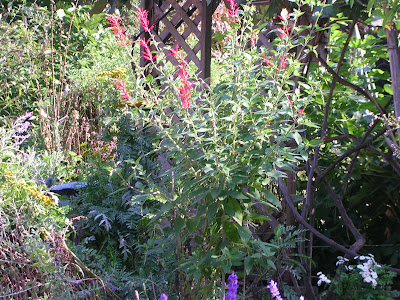
I came down our driveway today and the pineapple sage was in full bloom. Pineapple sage (Salvia elegans) flowers are edible. I actually said to myself, it's too bad the hummers aren't around any more. It happens every year, the pineapple sage blooms and the hummers are gone. Well, not this year! It may be tough to see, but trust me it was there. Here is the largest photo I can give you. It's right here in the middle.

Minggu, 21 September 2008

A Salvia Needed in the Garden

I am an herb plant collector. We have a lot of herb plants that reside in our basement and garage in the winter. This is a Peruvian salvia called Salvia discolor 'Andean Silver'. The blooms are black and the leaves are green with a white backing. It may be one that is dug up and placed in a pot for the winter. Not what my husband wants to hear! You can find this plant at Companion Plants and Well-Sweep Herb Farm.

Sabtu, 20 September 2008

An Herbal Annual Powerhouse-'Lemon Gem' Marigold

I just love this annual flower. It is an edible form of marigold and the only one I would suggest you eat. It is 'Lemon Gem' marigold, Tagetes tenuifolia. They come in other colors, including 'Tangerine Gem' and 'Orange Gem'. I bought one of the other varieties. The 'Lemon Gem' was the runt and it has come on gangbusters over the other variety. They are as I mentioned an edible flower. I decorate my pasta salad with cherry tomatoes and 'Lemon Gem' marigold flowers. A very pretty combination. You need to remember to eat only organically grown flowers and only eat the petals, not the pollen in the center of the flower. This flower also makes a lovely hedge of flowers when placed together in a row. Enjoy these last days of summer!

Rabu, 17 September 2008

One of My Favorite Herbal Flowers

As I was wandering in my garden the other day, I came upon one of my favorite herbal flowers, bee balm Monarda didyma. It is also known as bergamot and oswego tea. It is a native American herb. It is a hardy perennial that grows to about 3 feet tall. It likes full sun, but it can take partial shade. It comes in several different colors, pink, purple, magenta, red and white. I have red in great numbers because it is a favorite of the hummingbirds. When the kids trick or treat at my house, their parents want to know what the lovely smell is and it is usually the bee balm. It has very fragrant leaves that you can use in tea, fruit salads or potpourri. Its roots are rhizomes and are very easily divided and moved when you want it in several different places in your garden. It can be cut back once it blooms and it may rebloom. It can get powdery mildew. The bee balm in the picture is 'Jacob Kline' not as prone to mildew. Enjoy these last days of summer!

Senin, 15 September 2008

Wish You Could Smell This!

Several years ago I was visiting Well Sweep Herb Farm in New Jersey and brought home a Cestrum nocturnum (Night Blooming Jasmine). It has been glorious all summer and then my husband transplanted it just after it bloomed the first time and it set all new flowers and it has been blooming since. It is a very special plant. Just close your eyes and imagine the most wonderful jasmine smell in the world.

Kamis, 11 September 2008

That Mystery Herb-Stevia

During my herbal cleanup day, I came across a layer of herbs that I didn't recognize right away. I broke my cardinal rule of not labeling a layer when it was different than the rest. I came to my senses and remembered what it was. It is stevia (Stevia rebaudiana), the sweet herb of Paraguay. It has been used for hundreds of years by the Guarani Indians of Paraguay. It is 300 times sweeter than sugar. I did a little experiment today and brewed seven leaves in a cup of hot water. I don't usually like sugar in my tea or coffee, but it was slightly sweet and minty. It was quite good. I may use it this winter in a mix of herbs for tea. My plant is just about to bloom. I guess I need to start cutting it and drying it for winter use.  This is the one herb that is OK to cut after it has bloomed.  You know I always preach, cut before it blooms for best flavor.  Stevia is an exception.   I bought it to use in an herbs in container class I taught earlier in the year. If it had stayed in the container, I probably would have had to pot it up to the next size or keep it clipped back during the season. Here is a picture of stevia in my herb garden.


Jumat, 05 September 2008

Chives for All Times


I was in the garden the other day and snapped this picture of the garlic chives, Allium tuberosum and the curly chives, Allium senescens var. 'glaucum' just to the left with the pink flowers. You can eat the flowers of the garlic chives. The curly chive flowers are more ornamental. Regular chives have a round leaf that is hollow and garlic chives have a flat leaf. Regular chives have a mild onion flavor and garlic chives have a mild garlic flavor.
When the regular chives are blooming in the spring (photo below), my husband makes me a chive blossom omelet. Don't do what he does! Break apart a blossom and sprinkle on the egg mixture. He has put NINE blossoms in an omelet on several occasions. He has to be reminded every year! Maybe more about my statue named Mary next time. Until then.

Kamis, 04 September 2008

Purple Angelica


I promised to post some pictures of the purple angelica or Angelica gigas or Korean Angelica. It has been just amazing! Hope you enjoy it.


You can find purple angelica online at Companion Plants or Mulberry Creek Herb Farm. Here is a closeup picture of the flowers. They were just full of beneficial insects.

Senin, 25 Agustus 2008

The Year of Angelica


I'm always looking for a big herb to fill in spaces in my herb garden or elsewhere in the garden. This was the year of angelica in my herb garden. Angelica is a biennial, but if it likes its place, it goes CRAZY. It is a little hard to see in this picture, but it is in the back near the grape arbor. It was 7 feet tall! The seeds can be collected but have to be planted within 3 months of harvesting. It is a beautiful architectural plant in the garden. Does better with some shade. You can candy the stems for a treat.
Here is a recipe from Bertha Reppert's book, Growing and Using Herbs with Confidence.
CRYSTALLIZED ANGELICA
24 6-inch pieces of angelica (large hollow stalks, fresh)
2 cups water
2 cups granulated sugar
To prepare the angelica, soak it in cold water for several hours; plunge it into boiling hot water until, when pressed with your fingers, all stringy parts are easily removed. Do this under cold water. Boil a simple syrup of the water and sugar. Place the prepared angelica in the hot syrup (225 degrees F) for 24 hours; drain, reheat the syrup, and repeat three times. On the fourth day, boil the syrup and angelica at 245 degrees F. Remove from heat; cool. Drain; sprinkle with sugar. Dry thoroughly (this may take two weeks); store in a tin. Keeps indefinitely.
I will post a picture soon of a purple angelica. It has purple stems and flowers. It makes a real statement in a shady part of a garden.