
Why is digestion important?
Unless something goes wrong it’s easy to stop thinking about the food that goes into your mouth until it comes out the other end, hopefully 12 – 24 hours later. Digestion is largely involuntary, meaning that, after you’ve done the conscious act of chewing and swallowing, your amazingly intelligent body takes over.
We can’t necessarily say that one system of the body is more important than the other, as we need all of them to operate optimally. However, special props can be given to the digestive system. In this set of organs, mucosa, secretions, and nerves lies the ability to turn nutritious food, which is completely unusable in its whole form, to molecules tiny enough for the body to assimilate and use for various functions. I’ll say it here, and probably a 100 more times before I am done with this series, the body is absolutely amazing.
Herbalist, Michael Tierra, says that in the Ayurvedic system, digestion is the key to overall health. He continues further to say that, in Traditional Chinese Medicine, disease is said to begin in the stomach.
As important as the digestive functions are, herbalist David Winston reports that up to 2/3 of his clientele show signs of impaired digestion. You can probably imagine that if a body is not digesting food properly then it’s not getting the essential nutrients the whole body needs for vibrant health throughout the whole body. But before we explore sluggish systems and various pathologies in the digestive system let’s expand on how exactly it works.
The Digestive Process
(Or A Day in the Life of Your Food)
As stated above, the digestive process starts with the voluntary action of the intake, chewing, and swallowing of food. Normally your salivary glands produce just enough saliva to keep your mouth moist, but even before the food hits your tongue, your salivary glands are ideally secreting extra saliva. About 1 to 3 pints of saliva a day is produced in the mouth and yes, you can have too much or too little. Saliva is mostly made up of water but also includes special enzymes used to break down starches and sugars. The salivary reflex is started when you smell delicious food or eat sour or bitter foods.
We’ve all heard that we need to chew our food well (so you do right?). Chewing is important as the first step in changing the food into smaller molecules. It also allows for the mixing of saliva with the food to further break down starches and sugars. Besides saliva, your tongue, teeth, and gums all play an important role in this process.
Once you’ve swallowed your hopefully well-chewed food (called the bolus), it enters the esophagus. The esophagus is lined with muscles and the involuntary muscle action of peristalsis helps to move the food down to your stomach. This means that you could hypothetically eat while standing on your head, although such an action is not advised or endorsed by this author. The voyage from being swallowed to entering the stomach takes about 2 to 3 seconds.
At the bottom of the esophagus is the lower esophageal sphincter, which is a ring-like muscle that creates a barrier between the esophagus and the stomach. This sphincter relaxes when food enters the stomach, and tightens up again once the food has passed. Problems arise when this sphincter remains relaxed, allowing for the gastric juices of the stomach to rise into the esophagus, creating what you think would be called esophageal burn but, instead, somebody named it heartburn, overlooking the fact it has nothing to do with your heart. (I admit, however, that heartburn is much easier to say.)
Heartburn is often treated allopathically with antacids, which neutralize the acids in your stomach. Taking antacids may alleviate the pain for the time however they also severely hamper digestion, creating even more problems down the line. Herbalist David Winston says it’s important to determine the cause of the heartburn, whether from too much stomach acid, or from a relaxed esophageal sphincter, and then work to find a solution from there. His CD on digestion is very illuminating and is referenced in the suggested readings at the end of this article.

The Stomach
Once your food has made it to your stomach it may be there for up to a couple of hours. The stomach has three important physical functions. It stores consumed food and liquid, it mixes this with gastric juices to further break it down into a liquid, and, lastly, it slowly empties the food (now called chyme) into the small intestine (which is by no means small by the way).
The stomach is lined with mucosa that helps to protect it from the intense acids it produces to break down food. This specialized mucosa does not allow for much absorption of nutrients although it does break down some water, some electrolytes, certain drugs (especially aspirin), and alcohol. (This is why tinctures act on the body so quickly.)
Much of the digestive system is made up of mucosal tissue. When inflamed due to chronic inflammatory processes (Crohn’s disease, ulcers), or acute inflammation (diarrhea, heartburn), demulcent herbs such as marshmallow root, comfrey, and slippery elm can be used to soothe the irritated tissue. (Please read up on the controversial comfrey before taking it yourself.)
How much time your food stays in the stomach depends a lot on the type of food that you ate. Carbohydrates stay in the stomach for the least amount of time, followed by proteins, and then fats. (Knowing how fast your body metabolizes food is part of what can help you to determine which foods work best for you. For example, if your body has a fast metabolism, eating too many carbohydrates can leave you with frequent hunger and on a roller coaster of fluctuating energy. If, on the other hand, you have a slower metabolism, eating too much fat can leave you feeling too full and heavy long after you’ve eaten.)
Small Intestine
Once your stomach has finished processing the chyme, it slowly enters it into the small intestine where 90% of the digestive function takes place. This hollow organ is an average of 22 feet long in an adult and is from 1.5 to 2 inches wide. It is covered in a mucosal lining along with small villi that all help to absorb the nutrients that will be assimilable by the body with the help of several digestive juices from the liver, pancreas, and the small intestine.
Bile
Bile is produced by your liver and stored in your gallbladder between meal times. When you start to eat, especially if there are bitter tastes in your food, the liver produces bile and the gallbladder squeezes out bile through ducts that enter into the small intestine. The bile has the specific action of breaking down fats.
Pancreatic enzymes
The pancreas produces a wide range of enzymes that further break down the carbohydrates, proteins, and fats in your food.
As your food changes into smaller and smaller molecules with the help of these various digestive juices it becomes ready for absorption through the small intestine.
Absorption
With the help of these digestive juices the chyme is broken down into smaller and smaller molecules and then finally absorbed into the circulatory system. Fat-soluble vitamins are stored in the liver and adipose of the body, while extra water-soluble vitamins are excreted through the urine. Water is also absorbed through the walls of the small intestine. Twenty two feet later it begins a slow entry into the large intestine.
Large Intestine
The large intestine has several roles. It absorbs most of the remaining water as well as a few vitamins and electrolytes. It also holds the chyme until ready for evacuation.
One interesting thing about the large intestine is the ascending colon. As the name suggests, it literally travels up your right side before becoming the horizontal transverse colon, and then finally the sigmoid portion which travels down and ends at the anus. In view of this anatomy, it makes sitting on a toilet to defecate a very unnatural phenomenon because it forces your body to work against gravity. Much more appropriate is to squat, which arranges your large intestine in a way that facilitates defecation. If you look around the world, squatting is much more common than our more modern, and supposedly superior, porcelain thrones.
The large intestine (and small intestine) is home to an amazing amount of bacteria that participate in further fermenting and breaking down your food. (Herbalist Chanchal Cabrera says that the bacteria in your colon could weigh as much as three pounds!). It is this fermentation that causes gas and flatulence. Gas can be an annoying nuisance or even extremely painful. Carminatives such as mints, fennel, chamomile, cardamom, and thyme are aromatic herbs that help to expel gas. Cooking with these herbs can help a problem before it starts. (This practice is inherent in some cultures, which is why you always find fennel candy as you walk out of the Indian restaurant after eating a meal; wonderfully spiced with carminatives.)
In a healthy person these bacteria are varied and abundant. Bacteria can become easily imbalanced with the use of antibiotics, diarrhea, poor food choices such as an abundance of sugar, and extreme colon cleansing programs. Traditional cultures around the world ate small amounts of fermented foods with every meal. This wisdom can be employed today to create and maintain a healthy balance in your colon. Some examples of fermented foods are kim chee, sauerkraut, miso, kefir, beet kvass and many more.
Appendix
When researching for this article I ran into several references amazingly still referring to the appendix as useless. (I have a hard time believing that this incredible human body contains useless organs.) In fact recent research suggests that the appendix plays a huge role in the immune system. Herbalist Jim McDonald says there’s research showing it may also repopulate the bowel with healthy bacteria after it has been purged.
After the remaining nutrients and water are absorbed, the same peristalsis action that moved the food down your esophagus pipe now acts in the large intestine, moving it closer to the exit hole and creating the reflex to defecate. All that remains is some water, indigestible food, bacteria, products of bacterial decomposition, and inorganic salts.
Diarrhea happens when the food is moved through the system too quickly and water is not properly absorbed. This can happen because of irritants in the intestines. Astringents like blackberry and raspberry leaves can be taken to tone the tissue for better absorption, although for the most part it’s a good idea to initially let your body expel whatever it is trying to get rid of. The focus should be on staying hydrated and getting electrolytes.
Constipation, on the other hand, is when the fecal matter stays in the large intestine too long. Most commonly, this can happen from both hyper or hypo tonic tissue, lack of fiber in the diet, dehydration, lack of exercise, or excess mucous. Addressing these issues is much more effective in the long run than laxatives, herbal or otherwise.
David Winston recommends that transit time, the time food enters your mouth to the time it leaves your body, is around 12 to 24 hours. To determine your transit time eat a nice serving of cooked beets and then record the time until you notice them on the other end. A nice bowl of borscht should do it.
What controls all these processes?
Although I have tried to mainly focus on the organs of digestion, it’s impossible to cut the digestive system out of the body without at least acknowledging some other important roles. The nervous system, hormones, and the circulation system administer different actions in harmony with the digestive system, leading to the stimulation of digestive juices, reflexes to keep things moving, and then carrying the digested nutrients to the various parts of the body. In-depth discussion of these tasks could last another fives pages, and I am already feeling your waning energy. Please just take note of these forces and we’ll end the article with some suggestions on healthy digestion as well as further reading.
Ideas for healthy digestion
- Eat healthy food according to your constitution. To determine which foods work best for you I highly recommend the book Metabolic Typing. Rather than proclaiming dietary dogma it teaches self awareness to help a person actually figure out which foods, what size of meals, the best times of day for eating, etc, work for them.
- Eliminate food that you are allergic or sensitive to. Common sensitivities are wheat, dairy, and soy.
- Chew your food well. There’s no need to count to 100, just be sure that your food is well mashed before swallowing.
- Stay hydrated, but limit large amounts of liquids before, during, and after meals. This can dilute your digestive juices, impairing the breakdown of your food.
- Avoid extreme physical activity directly following meal times.
- Avoid frozen and iced beverages and foods at meal-time. The digestive process needs warmth, and is hampered by excessive coldness.
- Eat until you are only ¾ full.
- Eat fermented foods with your meal. Miso, sauerkraut, kefir, beet kvass, etc.
- Eat your bitters. Bitter foods and herbs stimulate the salivary glands and the expulsion of bile, all facilitating digestion. Bitters include dandelion leaves, orange peels, gentian, yellow dock, and hops.
- Eat sitting down. Avoid watching TV or reading while eating.
- Don’t eat when tense, angry, or fearful. These emotions have direct effects on your nervous system, which in turn affects digestion.
- Avoid harsh cleansing programs like gall bladder flushes and colon cleansing.
- Enjoy your meal. In Ayurveda it’s said that singing before and after a meal promotes digestion.
Suggested Reading
David Winston, Digestion CD from the Herbal Therapeutics Library
Metabolic Typing, William Wolcott. This book helps you to determine which foods work best for you.
Herbs for the Digestive System, article by Jim McDonald
Jim McDonald’s Article Index. I used this resource extensively for the article. Here you will find many articles related to specific pathologies of the digestive tract. Many thanks to Jim for putting together such quality articles in one easy-to-locate place.
I particularly referenced the following from this index:
Phytotherapeutic approaches to lower bowel disease Pt1 and Pt2 by Chanchal Cabrera.
Great look at digestive health and many chronic issues.
Herbalist's View - Digestion by 7song
Principles of Anatomy &f Physiology, Tortora, Grabowski. For an in-depth look at the digestive system.
Thanks to http://eatwellgetwell.wordpress.com/ for the image.
This article was written to give you a brief view of the digestive system interspersed with herbalists’ perspectives on digestive health and digestive pathologies. It is not meant to treat, diagnose, or cure.
This article was originally written for HerbMentor.com as part of the Anatomy and Physiology for Herbalists series.

 We tried a lot of things - both gentle and not so gentle... some downright diabolical... but still the groundhogs remained. Some of the shrubs in the area died (note: shrubs do not do well when doused with peppermint oil), but the groundhogs continued eating my perennials and digging away under the steps. Eventually someone told me that they don't like noisy surroundings. AHA! I stuck up some windchimes near the hole. They either began hibernation early OR they've moved on. I am quite certain that they are out there procreating as I write, as they are mutants and indestructable.
 Until last night. I've gotten used to living on a windy hill. It took a couple of springs, but I'm ok with it now. The sound of wind trying to rip off siding and shingles is no biggie. The gusts that shake the house and rattle the windows are no longer frightening. However, last night the wind chimes sounded like perhaps Zeus was pounding out some armor. Every so often the wind would die down for 30 seconds or so - long enough for me to doze off - only to rise again with a resounding clanging and banging. It was an astoundingly loud night. I can hear the groundhogs laughing, off in the distance.


 Brilliant blue skies, and fresh air were just impossible to resist. We had mountains of work to do, and most of it got done (or will in time). The magazine will be shipped tomorrow. We weighed 19 batches of soap, and the fats were darned near frozen! We need to find a way to store the pallets in a warm place. It is amazing how hard frozen fat can be.... We pulled and started wrapping a couple of wholesale orders, and I even put some work into the word puzzle book while unwinding during the evenings.
 The path winds along beside the creek. There is a wee bit of ice clinging to the edges of the creekbed, and almost nothing is green save for the chickweed and garlic mustard. Occasionally there are some emerald ovals of honeysuckle or a random rosehip. There are many, many deer in the area, so they've picked the briars clean. We will be planting more food this spring in the form of native shrubs.
 This log (and ONLY this log) was covered with these little puffball/galls or something. I assume they were a fungus of some sort. This was across the creek from me and there wasn't a good access nearby to cross without getting soaked.
 At this time of the year, the textures of the trees are really striking. There is a good bit of diversity in the woods, and at least 10 varieties are represented. Probably more, but I haven't really thought to count them in the summer. Hmmm... there's a project. It isn't as noticeable in the spring and summer when we are busier looking at the lush greenery. Now, in the starkness of winter, the beauty of the barks is clearer.
 I leaned up against a tree and looked up. The wind had all of the trees swaying and it was hypnotic. After a while, I realized that many of the trunks in the thinner trees were also swaying - and the ground is very soggy. That was a bit unnerving!
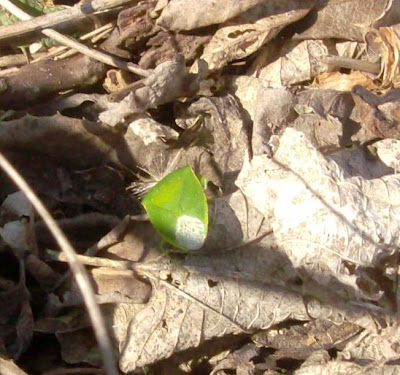
 This prehistoric looking, shield-shaped creature is a stinkbug. They are one of the most prevalent (ok - aside from the flies!) bugs around, and they just want IN my house. A live one plopped onto my stove the other night from heaven knows where. I've never seen one in this color stage before. They are typically the color of the dry leaves surrounding this one. Grayish brown. They really look un-real to me when they are older... like transformers or armored tanks with legs. At least this one looks like a bug.
 Upon my return, these chickens were somewhat indignant to be disturbed. They gave me a good talking to as I entered the shop to continue with the weighing of the fats. They like to dig shallow indentations right up against the foundation to stay warm, and the sun hits that side of the shop all day long.
 Later, the moon rose as I was finishing up dinner on the grill. This shot is deceptively dark. It was still very light out, and directly behind me on a level with the moon, was the sun. It was a beautiful end to a spectacular day.


